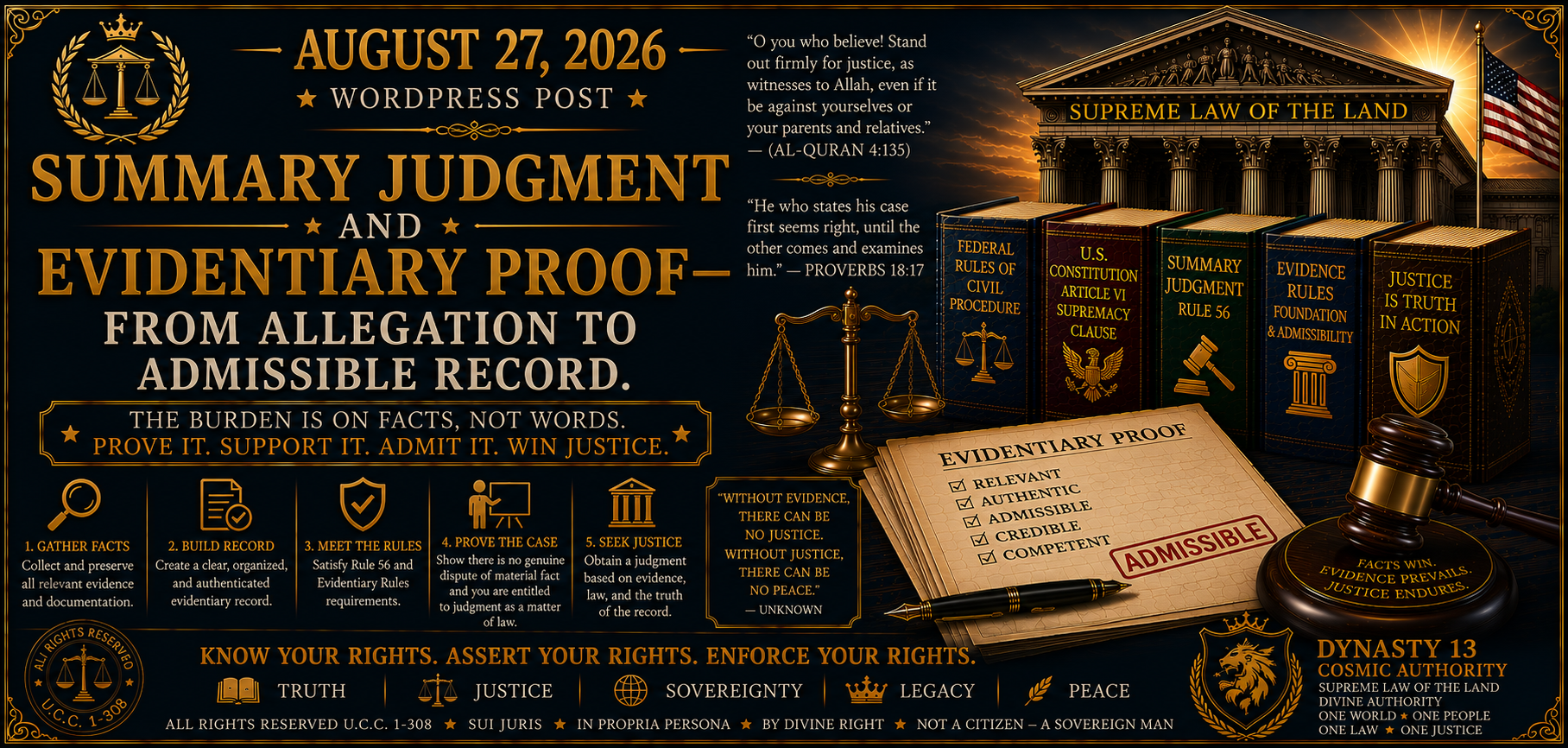


# Summary Judgment and Evidentiary Proof: From Allegation to Admissible Record
**The Federal Civil Action and Lawful Record Series — Part 6**
**Scheduled publication:** August 27, 2026
**Reading time:** Approximately 5 minutes
**WordPress slug:** `summary-judgment-evidentiary-proof-admissible-record`
**Category:** Universal Court Law
**Tags:** summary judgment, Rule 56, admissible evidence, declarations, authentication, apostille, treaty claims, Circle Seven
## When Allegation Must Become Proof
A complaint begins with factual allegations. Discovery develops the evidence. Summary judgment asks whether the resulting record contains a genuine dispute requiring a trial.
Under Federal Rule of Civil Procedure 56, a court must grant summary judgment when the movant shows there is no genuine dispute concerning a material fact and the movant is entitled to judgment as a matter of law.
This is not permission for a judge to resolve credibility disputes that properly belong to a jury. It is a procedure for separating claims supported by triable evidence from claims resting only on pleadings, conclusions, or speculation.
The governing text should always be read together with the court’s scheduling order, local rules, and the assigned judge’s procedures. [Federal Rule of Civil Procedure 56](https://www.law.cornell.edu/rules/frcp/rule_56).
## Black’s Law and the Language of Proof
Relevant terms from **Black’s Law Dictionary, 12th Edition** may be paraphrased as follows:
* **Summary judgment** is judgment entered without a full trial when no genuine dispute of material fact requires fact-finding.
* A **material fact** is a fact capable of affecting the outcome under the governing substantive law.
* A **genuine dispute** exists when the evidence would permit a reasonable fact-finder to decide for the nonmoving party.
* The **burden of production** is the obligation to present sufficient evidence on an issue.
* The **burden of persuasion** is the obligation to convince the fact-finder to the required legal standard.
* An **affidavit** is a written factual statement confirmed by oath or affirmation.
* A **declaration** may serve a similar evidentiary function when executed under penalty of perjury as authorized by law.
* **Authentication** is the process of showing that evidence is what its proponent claims.
* **Hearsay** generally concerns an out-of-court statement offered to prove the truth of what it asserts, subject to exclusions and exceptions.
* **Judicial notice** permits a court to accept certain facts not reasonably open to dispute.
Black’s remains a legal reference rather than an independent source of jurisdiction or substantive rights. [Thomson Reuters’ Black’s Law Dictionary reference](https://www.thomsonreuters.com/en/press-releases/2024/june/thomson-reuters-releases-12th-edition-of-black-s-law-dictionary).
The word **summary** developed from Latin language concerning a sum or concise statement. **Judgment** is connected to the act of judging and formally declaring a legal conclusion. **Proof** traces through language associated with testing, demonstrating, and establishing validity. These roots reveal the movement required by Rule 56: from assertion, through testing, to a judicial determination. [Etymology of “summary”](https://www.etymonline.com/word/summary), [“judgment”](https://www.etymonline.com/word/judgment), and [“proof”](https://www.etymonline.com/word/proof).
## The Supreme Court’s Summary-Judgment Framework
Four Supreme Court decisions provide an essential framework.
In **Celotex Corp. v. Catrett**, 477 U.S. 317 (1986), the Court held that, after adequate time for discovery, summary judgment may be entered against a party who cannot establish an essential element on which that party bears the trial burden. A movant need not always produce evidence disproving the opponent’s case; the movant may identify an absence of supporting evidence. [Official Celotex opinion](https://tile.loc.gov/storage-services/service/ll/usrep/usrep477/usrep477317/usrep477317.pdf).
In **Anderson v. Liberty Lobby, Inc.**, 477 U.S. 242 (1986), the Court explained that a factual disagreement is “genuine” only when the evidence would allow a reasonable jury to return a verdict for the nonmovant. The substantive burden of proof governing the claim matters. [Official Anderson opinion](https://tile.loc.gov/storage-services/service/ll/usrep/usrep477/usrep477242/usrep477242.pdf).
In **Matsushita Electric Industrial Co. v. Zenith Radio Corp.**, 475 U.S. 574 (1986), the Court held that an opponent must present more than speculation or metaphysical doubt. The evidence must support a reasonable inference in the opponent’s favor. [Official Matsushita opinion](https://tile.loc.gov/storage-services/service/ll/usrep/usrep475/usrep475574/usrep475574.pdf).
In **Scott v. Harris**, 550 U.S. 372 (2007), the Court declined to accept a factual version that was plainly contradicted by an authenticated video recording. The case illustrates the power of reliable objective evidence, although courts ordinarily draw reasonable inferences for the nonmoving party. [Official Scott opinion](https://tile.loc.gov/storage-services/service/ll/usrep/usrep550/usrep550372/usrep550372.pdf).
## Building the Rule 56 Record
Rule 56 permits parties to cite particular parts of:
* Depositions;
* Documents;
* Electronically stored information;
* Affidavits or declarations;
* Admissions;
* Interrogatory answers;
* Stipulations;
* Other record materials.
A record citation should identify the exhibit, page, paragraph, timestamp, or deposition line supporting the proposed fact. Giving the court hundreds of unsorted pages and expecting it to locate supporting evidence is hazardous.
Local practice is equally important. Some courts require separately numbered statements of undisputed material facts and paragraph-by-paragraph responses. Other courts prohibit a separate statement unless the judge orders one. Always examine the applicable local rule.
Failure to properly controvert a factual statement can result in that fact being treated as undisputed. Nevertheless, nonresponse does not automatically entitle the movant to win—the court must still determine whether Rule 56 and the substantive law authorize judgment.
## Affidavits and Unsworn Declarations
Rule 56(c)(4) requires a supporting declaration or affidavit to:
1. Be based on personal knowledge;
2. Present facts that can be admitted in evidence;
3. Show that the witness is competent to testify.
Under **28 U.S.C. §1746**, many federal matters that permit a written affidavit may instead be supported by a dated and signed unsworn declaration stating that its contents are true and correct under penalty of perjury. A substantially compliant declaration can therefore have evidentiary force without notarization. [Official text of 28 U.S.C. §1746](https://uscode.house.gov/view.xhtml?req=%28title%3A28+section%3A1746+edition%3Aprelim%29).
Neither notarization nor the words “affidavit of truth” automatically prove every statement in a document. A notary generally verifies a signature, oath, or acknowledgment according to applicable law. The notary does not ordinarily determine that every factual or legal assertion is correct.
A self-created document also does not become binding merely because another person failed to answer it. Silence creates a binding admission only when an applicable rule, contract, statute, or established legal duty gives silence that effect.
## Authentication Is Not the Same as Truth
Federal Rule of Evidence 901 requires sufficient evidence to support a finding that an item is what its proponent claims. This may be established through witness knowledge, distinctive characteristics, public records, or evidence describing a reliable process or system. [Federal Rule of Evidence 901](https://www.law.cornell.edu/rules/fre/rule_901).
Certain documents are self-authenticating under Rule 902, including specified certified public records, acknowledged documents, official publications, business records accompanied by proper certification, and qualifying electronic evidence. [Federal Rule of Evidence 902](https://www.law.cornell.edu/rules/fre/rule_902).
Authentication addresses identity and origin. It does not necessarily establish:
* The truth of everything written;
* Freedom from hearsay;
* Relevance;
* Ownership;
* Jurisdiction;
* Nationality;
* Diplomatic status;
* The existence of governmental authority.
A digital hash can help demonstrate that a file has not changed. It does not independently prove who created the file, whether its statements are true, or whether the document has legal effect.
## Apostilles and Foreign Public Documents
The Hague Apostille Convention simplifies the international authentication of public documents by replacing traditional diplomatic legalization with a single certificate issued by a designated competent authority. [HCCH Apostille Convention information](https://www.hcch.net/en/instruments/conventions/specialised-sections/apostille).
An Apostille authenticates the origin of a covered public document—such as the relevant signature, official capacity, or seal. It does not certify the truth of the document’s contents or create substantive rights.
Federal Rule of Civil Procedure 44 and Federal Rule of Evidence 902 provide methods for proving foreign official records, including certifications authorized by an applicable treaty or convention. [Federal Rule of Civil Procedure 44](https://www.law.cornell.edu/rules/frcp/rule_44).
An Apostille placed on a private declaration does not transform that declaration into:
* A court judgment;
* A governmental commission;
* A diplomatic credential;
* A nationality determination;
* A land title;
* A treaty-created immunity;
* An enforceable order against persons who were never lawfully brought before a competent tribunal.
## Treaty Claims Require Evidence Too
A treaty citation does not eliminate the requirements of Rule 56. A party relying on a treaty should identify:
* The authenticated treaty text;
* The exact operative article;
* The persons, territory, and subject covered;
* Whether the provision is domestically enforceable;
* The admissible facts establishing a violation;
* The statute supplying jurisdiction and a cause of action;
* The legally authorized remedy.
For example, the U.S.–Morocco Treaty of Peace and Friendship may be established through its official publication. But the existence of that treaty does not itself prove that a particular person possesses Moroccan nationality, consular status, diplomatic immunity, ownership of property, or exemption from territorial law.
Treaty interpretation and proof of case-specific facts are separate inquiries.
## Scripture and the Duty to Verify
Al-Qur’an 2:282 emphasizes faithful recording and witnessing of obligations. Al-Qur’an 4:135 commands steadfast justice even when testimony operates against oneself or one’s relatives. Al-Qur’an 5:8 warns that hostility must not cause departure from justice. Al-Qur’an 49:6 teaches verification before acting upon a report.
The Royal Holy Divine Bible teaches in Deuteronomy 19:15 that serious factual matters should not rest on an unsupported accusation. Proverbs 18:17 observes that the first account may appear correct until it is examined by another. First Thessalonians 5:21 teaches the testing of matters and retention of what is good.
These teachings encourage truthful records, verification, corroboration, and impartial judgment. They do not replace evidentiary rules in a secular court, but they illuminate the ethical duty underlying those rules.
## Universal Law, Natural Law, and Evidentiary Discipline
Universal and Natural Law teaching may affirm that truth exists independently of governmental recognition. Positive law nevertheless determines how a factual proposition must be presented and tested in a particular court.
Moral certainty is not automatically evidentiary sufficiency. A sincere belief may be genuine yet still lack personal knowledge, authentication, corroboration, or an admissible foundation.
Lawful advocacy joins conscience with disciplined proof.
## Esotera: Inner Conviction and Outer Demonstration
Esotera teaching may distinguish between the **inner witness** and the **outer record**.
The inner witness is conscience—the individual’s conviction that an event occurred or an injustice was committed.
The outer record is demonstrable proof: testimony, authenticated documents, admissible communications, reliable electronic data, and properly established public records.
Inner conviction may motivate a claim. Outer demonstration determines whether the claim can survive summary judgment. Wisdom requires neither suppressing conscience nor confusing conviction with proof.
## The Circle Seven Summary-Judgment Test
Before filing or opposing a Rule 56 motion, ask:
1. What claim, defense, or element is being decided?
2. Who carries the burden of proof on that element?
3. What exact record citation supports or disputes each material fact?
4. Can the evidence be presented in an admissible form?
5. Is the disagreement genuine, or does it rest only on conclusions and speculation?
6. Have authentication, hearsay, privilege, and foreign-document requirements been addressed?
7. What precise judgment or partial ruling may the court lawfully enter?
## Model Statement of Material Fact
> **Material Fact No. __:** On ___, Defendant received the written notice identified as Exhibit __.
> **Record support:** Declaration of ___ ¶ __; Exhibit __; deposition of ___ at page __, lines __–__.
> **Why material:** This fact relates to the notice element of Plaintiff’s claim under ___.
> **Opposing evidence:** Defendant cites ___.
> **Nature of dispute:** The parties dispute receipt, not merely the legal consequence of receipt.
A useful declaration should state observable facts in numbered paragraphs, identify attached exhibits, explain how the declarant knows each fact, and avoid unsupported legal conclusions.
## Final Word
Summary judgment is the point at which pleading gives way to proof. A party cannot rely solely on accusations, private titles, unanswered notices, seals, Apostilles, or broad declarations of law.
The lawful record identifies each material fact, connects it to admissible evidence, addresses contrary proof, and explains why the governing law authorizes judgment.
Truth deserves disciplined presentation. That is where conscience, evidence, and lawful process meet.
**Educational notice:** This article provides general legal, procedural, historical, and religious education. It is not legal advice, does not determine the rules governing any particular case, and does not create an attorney-client relationship.


Leave a Reply