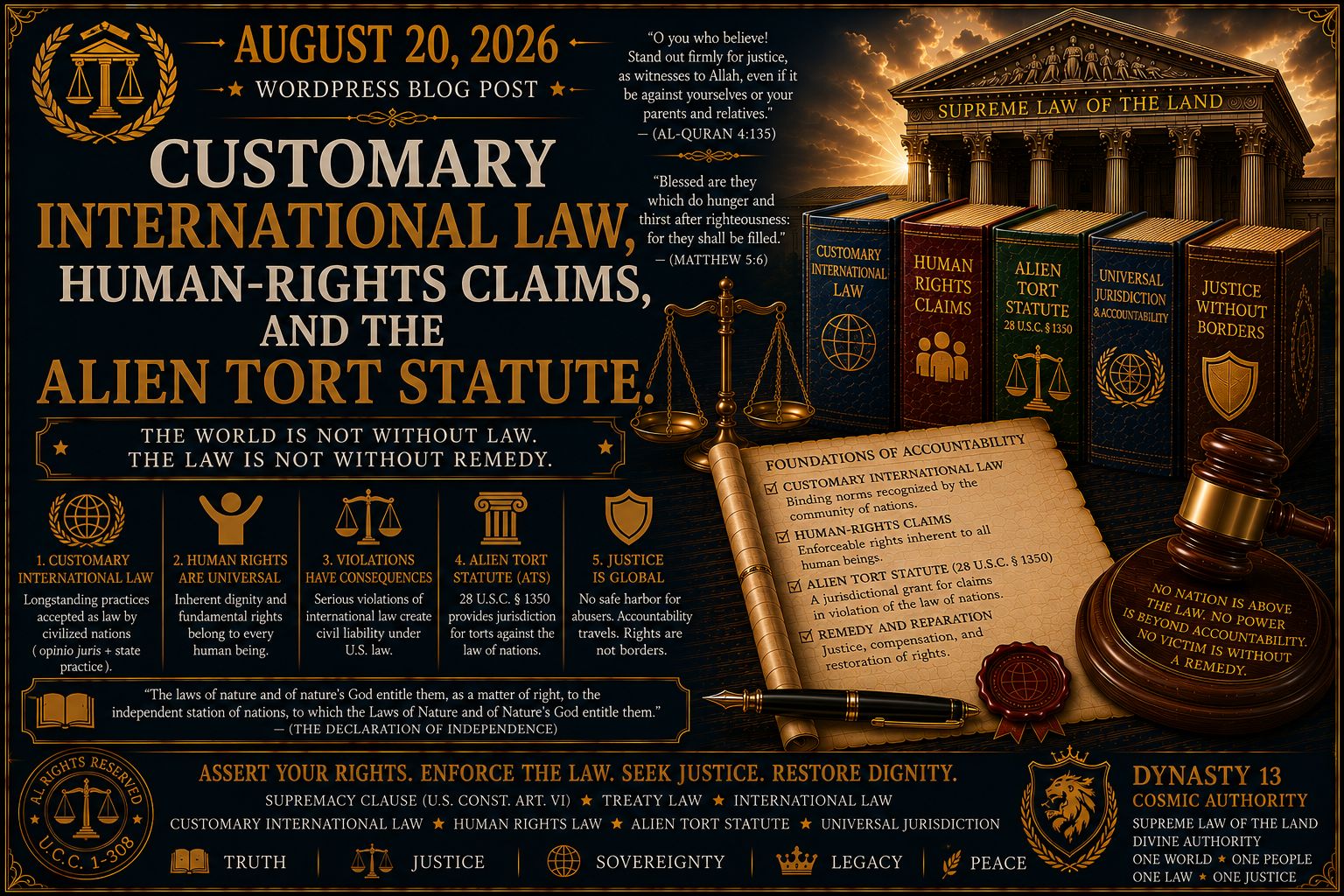


# Customary International Law, Human-Rights Claims, and the Alien Tort Statute
**The Treaty, International Covenant, and Civil Rights Claim Series — Part 6**
**Scheduled publication:** August 20, 2026
**Reading time:** Approximately 5 minutes
**WordPress slug:** `customary-international-law-human-rights-alien-tort-statute`
**Category:** Universal Court Law
**Tags:** customary international law, Alien Tort Statute, law of nations, human rights, natural law, Sosa, Circle Seven
## When International Wrong Becomes a Federal Claim
Universal Law and Natural Law teach that certain wrongs offend human dignity wherever they occur. Customary international law asks a different legal question: have nations generally followed a practice because they recognize it as legally obligatory?
The Alien Tort Statute asks an even narrower question: may a qualifying non-U.S. citizen bring a federal civil action for a tort committed in violation of the law of nations or a United States treaty?
These ideas are related, but they are not interchangeable. A moral wrong is not automatically an international legal norm, and an international norm does not automatically create a private federal lawsuit.
## Black’s Law and the Governing Words
Relevant terms from **Black’s Law Dictionary, 12th Edition** may be paraphrased as follows:
* **Customary international law** consists of international rules derived from sufficiently general state practice accepted as legally obligatory.
* The **law of nations** is the body of law governing relations among nations and, in limited circumstances, the international responsibilities of individuals.
* A **tort** is a civil wrong—independent of contract—for which the law may authorize a remedy.
* An **alien**, in the language of 28 U.S.C. §1350, generally means a person who is not a United States citizen.
* **Jurisdiction** is a court’s lawful authority to hear and decide a controversy.
* A **cause of action** is the legal basis authorizing a claimant to seek judicial relief.
* A **jus cogens** norm is a peremptory rule of general international law from which no derogation is permitted.
The twelfth edition of Black’s contains more than 70,000 law-related terms and phrases. [Thomson Reuters’ Black’s Law Dictionary reference](https://www.thomsonreuters.com/en/press-releases/2024/june/thomson-reuters-releases-12th-edition-of-black-s-law-dictionary).
The word **custom** comes through Old French from the Latin *consuetudo*, meaning habit, usage, practice, or tradition. [Etymology of “custom”](https://www.etymonline.com/word/custom).
**Tort** descends from Old French and the Latin *tortum*—a wrong—related to *torquere*, meaning to twist or turn awry. [Etymology of “tort”](https://www.etymonline.com/word/tort).
**Alien** comes from the Latin *alienus*, meaning belonging to another or foreign. In §1350, it is a legal classification connected to citizenship or nationality, not a spiritual condition or identity label. [Etymology of “alien”](https://www.etymonline.com/word/alien).
## How Customary International Law Is Identified
Article 38(1)(b) of the Statute of the International Court of Justice describes international custom as evidence of “a general practice accepted as law.” [ICJ Statute, Article 38](https://www.icj-cij.org/statute).
Two elements ordinarily must be shown:
1. **General state practice:** what governments consistently do through legislation, diplomacy, military manuals, official statements, judicial decisions, and other governmental conduct.
2. **Opinio juris:** evidence that states follow the practice because they believe international law requires it—not merely because it is convenient, polite, or traditional.
A United Nations resolution, scholarly article, moral declaration, or isolated judicial opinion can supply evidence, but it does not necessarily establish customary law by itself. The International Law Commission’s conclusions therefore require separate assessment of general practice and acceptance as law. [United Nations materials on identifying customary international law](https://legal.un.org/ilc/summaries/1_13.shtml).
## What the Alien Tort Statute Says
The Alien Tort Statute, 28 U.S.C. §1350, provides:
> The district courts shall have original jurisdiction of any civil action by an alien for a tort only, committed in violation of the law of nations or a treaty of the United States.
[Current official text of 28 U.S.C. §1350](https://uscode.house.gov/view.xhtml?edition=prelim&req=granuleid%3AUSC-prelim-title28-section1350).
The statute therefore presents at least four threshold requirements:
* The action must be filed in federal district court;
* The plaintiff must qualify as an alien under governing law;
* The alleged conduct must constitute a tort;
* The tort must violate a sufficiently established law-of-nations norm or an applicable United States treaty.
Nationality or alienage must be established through legally cognizable facts. A private declaration, religious title, identification card, nationality proclamation, or change of name does not by itself determine citizenship for §1350.
## The Supreme Court’s Restrained Framework
In **The Paquete Habana**, 175 U.S. 677 (1900), the Supreme Court famously recognized international law as part of American law where no controlling treaty or legislative, executive, or judicial act requires a different result. [Official Library of Congress record](https://www.loc.gov/item/usrep175677/).
That principle does not mean every international rule creates a private damages action.
In **Sosa v. Alvarez-Machain**, 542 U.S. 692 (2004), the Court held that the ATS is jurisdictional and does not itself create new causes of action. Courts may recognize only a narrow class of claims resting upon international norms with definite content and widespread acceptance comparable to the eighteenth-century offenses known when the statute was enacted: infringement of ambassadors’ rights, violation of safe conducts, and piracy.
The Court rejected the broad arbitrary-detention theory presented in *Sosa* because it lacked the necessary specificity. [Official Sosa opinion](https://tile.loc.gov/storage-services/service/ll/usrep/usrep542/usrep542692/usrep542692.pdf).
A claimant must therefore identify the exact international norm, demonstrate its specific and obligatory character, and establish that it governs the defendant’s alleged conduct.
## Territorial and Corporate Limits
In **Kiobel v. Royal Dutch Petroleum Co.**, 569 U.S. 108 (2013), the Supreme Court applied the presumption against extraterritoriality to ATS claims. When relevant conduct occurred abroad, a claim must connect to United States territory with sufficient legal force. Mere corporate presence is insufficient. [Official Kiobel opinion](https://tile.loc.gov/storage-services/service/ll/usrep/usrep569/usrep569108/usrep569108.pdf).
In **Jesner v. Arab Bank, PLC**, 584 U.S. 241 (2018), the Court held that foreign corporations may not be defendants in ATS actions unless Congress supplies further authorization. [Official Jesner opinion](https://www.supremecourt.gov/opinions/17pdf/16-499_1a7d.pdf).
In **Nestlé USA, Inc. v. Doe**, 593 U.S. 628 (2021), the Court held that allegations of general corporate decision-making in the United States did not establish a domestic ATS application when the conduct allegedly assisting forced labor occurred abroad. The decision did not categorically resolve every possible claim against a domestic corporation, but it requires more than ordinary corporate activity in the United States. [Official Nestlé opinion](https://www.supremecourt.gov/opinions/20pdf/19-416_i4dj.pdf).
The ATS is therefore not a general international human-rights court for every injury occurring anywhere in the world.
## The Torture Victim Protection Act
Congress created a more express remedy through the **Torture Victim Protection Act of 1991**, published as a statutory note following §1350.
The Act permits damages claims against an individual who, under actual or apparent authority or color of law of a foreign nation, subjects another individual to torture or extrajudicial killing. It also requires exhaustion of adequate and available remedies where the conduct occurred and establishes a ten-year limitation period. [Official TVPA text following §1350](https://uscode.house.gov/view.xhtml?edition=prelim&req=granuleid%3AUSC-prelim-title28-section1350).
In **Mohamad v. Palestinian Authority**, 566 U.S. 449 (2012), the Supreme Court held that “individual” under the TVPA means a natural person—not an organization. [Mohamad opinion](https://tile.loc.gov/storage-services/service/ll/usrep/usrep566/usrep566449/usrep566449.pdf).
When facts involve state or local officials in the United States, 42 U.S.C. §1983 may be the more appropriate vehicle. Other federal statutes may supply express civil remedies for trafficking or related conduct. The correct statute depends upon the actors, location, injury, protected right, and requested remedy.
## What Does Not Create an ATS Claim
Standing alone, the following generally do not establish an ATS cause of action:
* A broad appeal to Universal Law or Natural Law;
* A declaration that an act violated human dignity;
* Quoting the Universal Declaration of Human Rights without an enforceable legal vehicle;
* Citing the ICCPR without addressing the United States’ non-self-execution declaration;
* Invoking the Morocco Treaty without identifying an applicable article;
* Declaring oneself foreign, Moorish, Aboriginal, sovereign, or outside territorial law;
* Reserving rights under U.C.C. §1-308;
* Citing a criminal statute that contains no private civil remedy;
* Presenting a private constitution, seal, writ, or court certificate.
These materials may express identity, conscience, historical understanding, or moral principle. They do not substitute for subject-matter jurisdiction, personal jurisdiction, a valid cause of action, proper service, admissible evidence, or an authorized remedy.
Claims may also encounter sovereign immunity, foreign-official immunity, statutes of limitation, exhaustion requirements, forum non conveniens, political-question concerns, and rules governing extraterritoriality.
## Scripture and Justice Among Nations
Al-Qur’an 4:135 commands believers to stand firmly for justice, even when judgment concerns themselves or those close to them. Al-Qur’an 5:8 warns that hostility must not cause departure from justice. Al-Qur’an 16:90 joins justice with good conduct, while Al-Qur’an 42:42 condemns those who oppress people and transgress without right.
The Royal Holy Divine Bible teaches in Amos 5:24 that justice should flow continually. Isaiah 10:1–2 condemns unjust decrees that deprive vulnerable people of their rights. Psalm 82:3–4 calls for defense of the afflicted, and Micah 6:8 joins justice, mercy, and humility.
These scriptures support a universal moral command against oppression. A federal complaint must translate that moral conviction into recognized legal elements without misrepresenting scripture as a civil jurisdictional statute.
## Esotera: The Universal Wrong and the Judicial Remedy
Esotera teaching may distinguish between two forms of recognition.
The **inner recognition** perceives that torture, enslavement, oppression, and deliberate cruelty violate the sacred dignity of humanity.
The **outer recognition** asks whether sovereign states have accepted a definite rule as law and whether Congress or precedent authorizes a federal court to provide a remedy.
Inner recognition awakens conscience. Outer recognition establishes legal accountability. A disciplined claim respects both levels without confusing them.
## The Circle Seven ATS Test
Before filing or publishing an Alien Tort Statute claim, answer seven questions:
1. Is the plaintiff legally a non-U.S. citizen for purposes of §1350?
2. What specific tort was committed, and what facts establish each element?
3. What exact law-of-nations norm or United States treaty provision was violated?
4. Is the asserted norm specific, universal, and obligatory under *Sosa*?
5. What relevant conduct occurred in the United States under *Kiobel* and *Nestlé*?
6. Is the defendant legally proper, and do corporate or governmental immunities apply?
7. What cause of action, limitation period, exhaustion rule, and judicial remedy govern the claim?
Every answer should be supported by facts, authenticated evidence, controlling law, and accurate citations.
## Model Lawful ATS Allegation
> Plaintiff is a citizen of ___ and is not a citizen of the United States. Defendant allegedly committed the tort of ___ through the following specific acts: ___. Those acts violated the international norm prohibiting ___, which Plaintiff alleges is specific, universal, and obligatory under the authorities identified below. The relevant domestic conduct consisted of ___. Plaintiff invokes 28 U.S.C. §1350 for jurisdiction and identifies the lawful basis for the requested cause of action and remedy as ___. Plaintiff does not rely upon a private nationality declaration or spiritual title as a substitute for jurisdiction, standing, or evidence.
## Final Word
Customary international law is not created by personal assertion. It develops through general state practice accepted as law. The Alien Tort Statute does not transform every international injustice into a federal lawsuit; it opens a narrow jurisdictional door subject to demanding rules of specificity, territorial connection, defendant liability, and judicial restraint.
Universal Law may reveal the moral wrong. Natural Law may awaken conscience. Scripture may command justice. Esotera may illuminate the inward duty. But a lawful federal claim must still identify the plaintiff, tort, international norm, domestic connection, proper defendant, cause of action, and authorized remedy.
That is how universal conscience becomes disciplined international-law pleading.
**Educational notice:** This article provides general legal, historical, and religious education. It is not legal advice, does not create an attorney-client relationship, and does not establish private governmental, diplomatic, or judicial authority.


Leave a Reply