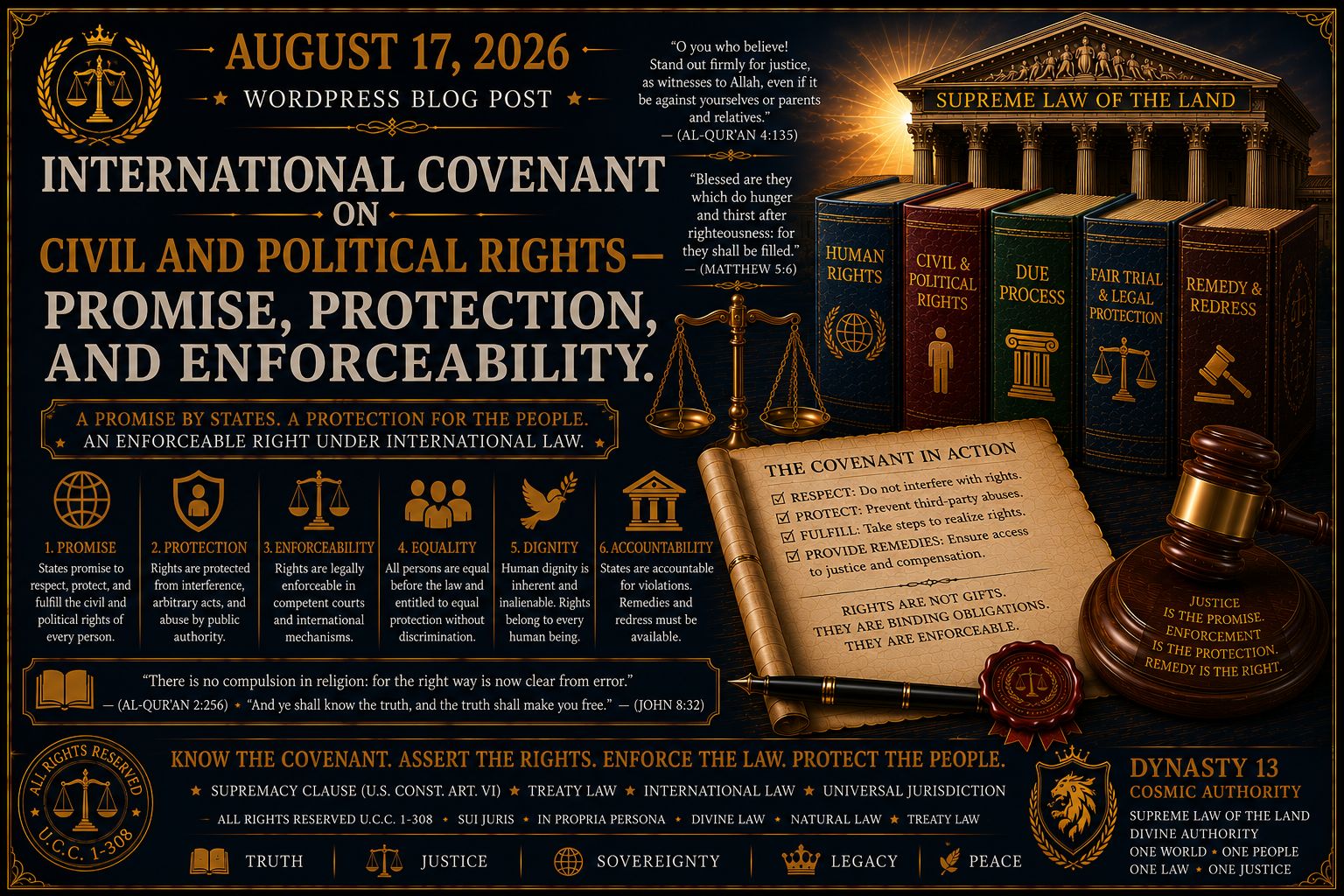


# The 1966 International Covenant on Civil and Political Rights: Promise, Protection, and Enforceability
**The Treaty, International Covenant, and Civil Rights Claim Series — Part 3**
**Scheduled publication:** August 17, 2026
**Reading time:** Approximately 5 minutes
**WordPress slug:** `1966-iccpr-rights-enforceability-united-states`
**Category:** Universal Court Law
**Tags:** ICCPR, international covenant, human rights, treaty law, civil rights, Article VI, Circle Seven
## A Covenant Binding Nations
The International Covenant on Civil and Political Rights—commonly called the **ICCPR**—is one of the principal international instruments protecting human dignity, liberty, equality, religious exercise, cultural identity, and fair judicial process.
The United Nations adopted the Covenant on December 16, 1966. It entered into international force on March 23, 1976. The United States signed it in 1977, deposited its ratification on June 8, 1992, and became bound internationally on September 8, 1992. [U.S. Department of State treaty record](https://2017-2021.state.gov/92-908/).
But a legally careful analysis must distinguish three propositions:
1. The ICCPR binds the United States as a matter of international law.
2. The Covenant informs the interpretation and evaluation of civil and political rights.
3. Its substantive provisions generally cannot be sued upon directly in a United States court because the Senate declared Articles 1–27 non-self-executing.
That third proposition determines how an ICCPR-based grievance must be converted into a cognizable domestic claim.
## Black’s Law and the Meaning of Covenant
**Black’s Law Dictionary, 12th Edition**, provides the legal vocabulary needed to understand this structure. Its relevant concepts may be paraphrased as follows:
* A **covenant** is a formal promise or agreement imposing obligations.
* **Ratification** is the authoritative approval by which a state expresses consent to be bound.
* A **reservation** is a statement excluding or modifying the legal effect of part of a treaty.
* An **understanding** explains how the ratifying government interprets a provision.
* A **declaration** records an official position concerning the treaty’s operation.
* A **self-executing treaty** supplies a domestic rule without additional legislation.
* A **non-self-executing treaty** requires implementing legislation before its provisions operate as enforceable domestic law.
The current edition of Black’s contains more than 70,000 legal terms and is edited by Bryan A. Garner. [Thomson Reuters’ description of Black’s Law Dictionary](https://www.thomsonreuters.com/en/press-releases/2024/june/thomson-reuters-releases-12th-edition-of-black-s-law-dictionary).
The word **covenant** comes through Old French from the Latin *convenire*: to come together, unite, or agree. Historically, it signified both a mutual compact and a solemn promise. [Etymology of “covenant”](https://www.etymonline.com/word/covenant).
**Civil** descends from Latin *civilis*, concerning society, public life, and civic order. **Political** ultimately derives from Greek *polis*, meaning the city or organized community. Thus, civil and political rights concern the relationship between the human person and organized public authority. [Etymology of “civil”](https://www.etymonline.com/word/civil); [etymology of “political”](https://www.etymonline.com/word/political).
## The Covenant’s Protected Rights
Articles 1–27 establish the Covenant’s substantive protections.
| Article | Protected principle |
| ————– | —————————————————– |
| Article 1 | Self-determination of peoples |
| Article 2 | Respect for rights and an effective remedy |
| Article 6 | Inherent right to life |
| Article 7 | Freedom from torture and cruel treatment |
| Article 8 | Freedom from slavery and forced servitude |
| Article 9 | Liberty and protection from arbitrary detention |
| Article 10 | Humane treatment of detained persons |
| Article 14 | Equality before courts and a fair hearing |
| Article 17 | Privacy, family, home, correspondence, and reputation |
| Article 18 | Thought, conscience, and religion |
| Article 19 | Opinion and expression |
| Articles 21–22 | Peaceful assembly and association |
| Article 25 | Participation in public affairs |
| Article 26 | Equality and nondiscrimination |
| Article 27 | Minority culture, religion, and language |
Article 27 protects persons belonging to ethnic, religious, or linguistic minorities from being denied the communal enjoyment of their culture, religion, and language. It does not, by itself, create a separate government, confer diplomatic immunity, or exempt an individual from generally applicable law. [Official ICCPR text](https://2covenants.ohchr.org/About-ICCPR.html).
Likewise, Article 1’s protection of the self-determination of **peoples** does not operate as an individual mechanism for unilaterally cancelling citizenship, defeating court jurisdiction, or creating an internationally recognized sovereign state.
## The United States’ Reservations and Declaration
The Senate gave its advice and consent subject to a detailed package of **reservations, understandings, declarations, and a proviso**, often abbreviated as “RUDs.”
Among the principal conditions:
* Article 20 cannot be used to restrict speech and association protected by the United States Constitution.
* The United States limited its acceptance of Article 7 concerning cruel, inhuman, or degrading treatment to protections supplied by the Fifth, Eighth, and Fourteenth Amendments.
* Certain criminal-procedure provisions were accepted according to stated United States interpretations.
* Implementation would occur through the federal, state, and local governments according to the American federal system.
* Most importantly, the United States declared Articles 1–27 **not self-executing**.
The full ratification conditions are preserved in the [Senate resolution of advice and consent](https://www.congress.gov/treaty-document/95th-congress/20/resolution-text) and the [United Nations depositary record](https://treaties.un.org/Pages/ViewDetails.aspx?chapter=4&clang=_en&mtdsg_no=IV-4&src=UNTSONLINE).
Non-self-execution does not mean that the treaty is meaningless or that the United States has no international obligation. It means that a claimant ordinarily needs an enforceable domestic source of law—such as a constitutional provision, federal statute, state statute, or implementing legislation—to obtain judicial relief.
## What the Supreme Court Has Said
In **Sosa v. Alvarez-Machain**, 542 U.S. 692 (2004), the plaintiff relied partly on Article 9 of the ICCPR to characterize an arrest as arbitrary under international law. The Supreme Court noted that the United States had declared the Covenant’s substantive provisions non-self-executing. It also refused to recognize the plaintiff’s broad arbitrary-detention theory as a sufficiently definite customary international-law claim under the Alien Tort Statute. [Official Sosa opinion](https://tile.loc.gov/storage-services/service/ll/usrep/usrep542/usrep542692/usrep542692.pdf).
In **Medellín v. Texas**, 552 U.S. 491 (2008), the Court explained the broader doctrine: an international obligation does not necessarily become an automatically enforceable domestic judicial rule. A non-self-executing commitment requires implementing legislation before courts can enforce it as domestic law. [Official Medellín opinion](https://tile.loc.gov/storage-services/service/ll/usrep/usrep552/usrep552491/usrep552491.pdf).
Therefore, writing “ICCPR violation” in a complaint is ordinarily insufficient. The pleading should identify a corresponding domestic cause of action.
## Translating the Covenant Into a Domestic Claim
An ICCPR concern may point toward enforceable American law:
| ICCPR concern | Possible domestic authority |
| ———————————– | —————————————————————- |
| Arbitrary arrest or detention | Fourth and Fourteenth Amendments; 42 U.S.C. §1983 |
| Denial of a fair hearing | Fifth, Sixth, or Fourteenth Amendment; appeal or habeas statutes |
| Religious discrimination | First Amendment; RFRA, RLUIPA, Title VII, or §1983 |
| Racial discrimination | Equal Protection Clause; Titles VI or VII; §§1981, 1983, or 1985 |
| Inhumane detention conditions | Eighth or Fourteenth Amendment; applicable civil-rights statutes |
| Privacy interference | Fourth Amendment and applicable privacy statutes |
| Suppression of protected expression | First Amendment and §1983 |
| Forced labor | Thirteenth Amendment and enacted anti-trafficking statutes |
The applicable authority depends on the defendant, governmental involvement, facts, injury, jurisdiction, limitation period, immunity, and requested remedy.
Criminal statutes generally do not create private civil causes of action unless Congress expressly provides one.
## International Review Is Different From a Lawsuit
Article 40 requires states to report to the United Nations Human Rights Committee. The Committee reviews compliance and issues observations and recommendations. The United States participated in its most recent review process in 2023. [OHCHR United States reporting record](https://tbinternet.ohchr.org/_layouts/TreatyBodyExternal/Countries.aspx?CountryCode=USA&Lang=EN).
The First Optional Protocol permits individual communications against participating states. The United States has not accepted that Optional Protocol, so an individual cannot ordinarily file an ICCPR communication against the United States through that procedure. [OHCHR Optional Protocol status table](https://tbinternet.ohchr.org/_layouts/15/TreatyBodyExternal/Treaty.aspx?Treaty=CCPR).
## Divine Scripture and Human Dignity
Al-Qur’an 17:70 teaches that the children of Adam have been honored. Al-Qur’an 4:135 commands steadfast justice even where judgment affects oneself or one’s relatives. Al-Qur’an 49:13 recognizes human nations and tribes as a means of mutual knowledge—not oppression.
The Royal Holy Divine Bible teaches that humanity bears the Divine image in Genesis 1:27. Isaiah 10:1–2 warns against unjust decrees that deprive the vulnerable of justice. Micah 6:8 joins justice, mercy, and humility.
These scriptures express the moral foundation beneath civil and political rights: human dignity does not originate in governmental permission. Yet a court still requires an enacted legal basis, competent jurisdiction, admissible evidence, and an authorized remedy.
## The Circle Seven ICCPR Claim Test
Before placing the Covenant in a complaint or formal record, determine:
1. Which ICCPR article corresponds to the alleged injury?
2. What government actor, policy, or event caused that injury?
3. What United States reservation, understanding, or declaration applies?
4. What constitutional or statutory provision independently protects the right?
5. What cause of action authorizes the lawsuit?
6. What court has jurisdiction, and what immunity or limitation defenses apply?
7. What remedy can that court lawfully grant?
The ICCPR can strengthen the moral and international-law framework of a claim. The domestic cause of action supplies its enforceable structure.
## Final Word
The Covenant is an international promise made among nations. Its principles bear witness to the dignity of the human person, the equality of peoples, religious liberty, cultural protection, and lawful judgment.
But the disciplined claimant must distinguish an international obligation from a privately enforceable remedy. The Covenant identifies the protected principle; domestic law must ordinarily provide the judicial vehicle.
That distinction does not dishonor the Covenant. It is the lawful method by which principle becomes pleading, pleading becomes proof, and proof becomes an available remedy.
**Educational notice:** This article provides general legal and religious education. It is not legal advice and does not create an attorney-client relationship.


Leave a Reply