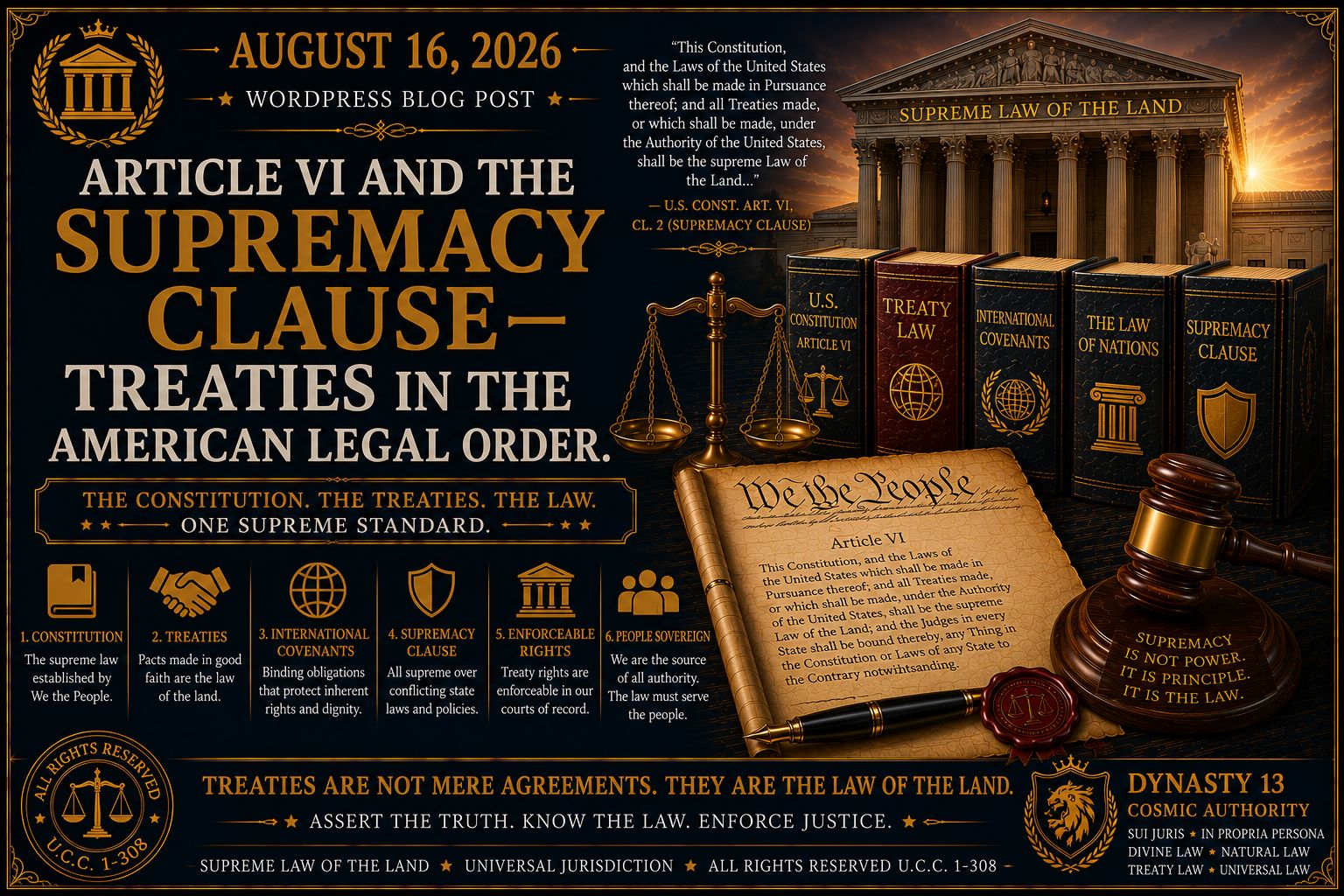


# Article VI and the Supremacy Clause: Treaties in the American Legal Order
**The Treaty, International Covenant, and Civil Rights Claim Series — Part 2**
**Scheduled publication:** August 16, 2026
**Reading time:** Approximately 5 minutes
**WordPress slug:** `article-vi-supremacy-clause-treaties-american-legal-order`
**Category:** Universal Court Law
**Tags:** Article VI, Supremacy Clause, treaty law, natural law, federal preemption, Circle Seven, civil rights
## The Supreme Law Is a Rule of Priority
Article VI of the United States Constitution establishes which public law controls when federal and state rules conflict. It does not make every international declaration, private covenant, religious constitution, or personal proclamation enforceable in court.
The essential language declares that the Constitution, valid federal laws, and treaties made under United States authority constitute the “supreme Law of the Land.” State judges are bound by that controlling law despite contrary state provisions. [Read Article VI through Congress’s Constitution Annotated](https://constitution.congress.gov/constitution/article-6/).
The Supremacy Clause therefore performs three related functions:
1. It places the Constitution above inconsistent governmental action.
2. It gives valid federal law priority over conflicting state law.
3. It permits qualifying treaty provisions to displace contrary state rules.
Supremacy is priority—not automatic jurisdiction, standing, damages, or a private cause of action.
## Black’s Law and the Language of Supremacy
The current **Black’s Law Dictionary, 12th Edition**, contains more than 70,000 legal terms. Its treatment of the Supremacy Clause may be paraphrased as the constitutional rule by which the Constitution, valid federal enactments, and treaties made under United States authority supersede conflicting state constitutions and laws. [Thomson Reuters’ Black’s Law Dictionary legal glossary](https://legal.thomsonreuters.com/blog/supremacy-clause-legal-glossary/).
The word **supreme** descends from the Latin *supremus*, meaning highest or uppermost. **Supremacy** describes the condition of occupying the highest position of authority. [Etymology of “supreme”](https://www.etymonline.com/word/supreme).
**Clause** comes through Old French and Medieval Latin from language signifying a conclusion, stipulation, or enclosed part of a legal writing. [Etymology of “clause”](https://www.etymonline.com/word/clause).
In constitutional law, **preemption** means that an applicable federal rule displaces an inconsistent state rule. Its older linguistic root concerned acting or taking priority “before” another claim. [Etymology of “pre-emption”](https://www.etymonline.com/word/pre-emption).
## The Lawful Hierarchy
The domestic hierarchy is more precise than the phrase “all treaties are supreme” suggests.
| Authority | Domestic legal position |
| ———————————— | ———————————————————————————————- |
| United States Constitution | Highest controlling public law |
| Valid federal statutes | Control conflicting state law |
| Self-executing treaties | May operate directly as federal law |
| Implemented treaty provisions | Operate through the implementing statute |
| Non-self-executing treaty provisions | Require legislation before courts can enforce them as domestic law |
| State constitutions and statutes | Valid unless displaced by controlling federal law |
| Private or religious covenants | Bind according to contract, association, or religious law—not Article VI merely by declaration |
A treaty cannot override the Constitution. In **Reid v. Covert**, the Supreme Court rejected the proposition that an international agreement could free government action from constitutional limitations. [Congressional explanation of treaties and constitutional limits](https://constitution.congress.gov/browse/essay/artII-S2-C2-1-9/ALDE_00012960/).
Federal statutes and self-executing treaties generally occupy equal domestic rank. When they cannot reasonably be harmonized, the later-in-time enactment may control in United States courts. A later statute can therefore prevail domestically even when its enactment may create an international responsibility for the United States. [Constitution Annotated discussion of the last-in-time rule](https://constitution.congress.gov/browse/essay/artII-S2-C2-1-7/ALDE_00012958/).
## The Supreme Court’s Treaty Instructions
In **Ware v. Hylton**, 3 U.S. 199 (1796), the Court applied a peace treaty against conflicting Virginia legislation concerning debts owed to British creditors. This is an early example of an operative treaty provision controlling contrary state law. [Official U.S. Reports opinion](https://tile.loc.gov/storage-services/service/ll/usrep/usrep003/usrep003199/usrep003199.pdf).
In **Whitney v. Robertson**, 124 U.S. 190 (1888), the Court explained that a self-executing treaty and an act of Congress have comparable domestic force. If the two are irreconcilable, the later rule controls.
In **Medellín v. Texas**, 552 U.S. 491 (2008), the Court distinguished an international obligation from a domestically enforceable rule. A treaty commitment that is non-self-executing does not automatically supply a judicial rule unless Congress has enacted the necessary implementing legislation. The Court also cautioned that even a treaty benefiting individuals does not necessarily create a private cause of action. [Official Medellín opinion](https://tile.loc.gov/storage-services/service/ll/usrep/usrep552/usrep552491/usrep552491.pdf).
In **Armstrong v. Exceptional Child Center**, 575 U.S. 320 (2015), the Court described the Supremacy Clause primarily as a rule for deciding which law controls—not a freestanding source of private rights or causes of action. The Court reiterated that formulation in **Kansas v. Garcia**. [Official Kansas v. Garcia opinion](https://www.supremecourt.gov/opinions/19pdf/17-834_k53l.pdf).
## Three Forms of Preemption
A claimant must identify an actual conflict, not merely pronounce federal supremacy.
* **Express preemption:** Congress expressly states that specified state law is displaced.
* **Field preemption:** Federal regulation is so comprehensive that Congress is understood to have occupied the regulatory field.
* **Conflict preemption:** Compliance with both rules is impossible, or the state rule obstructs the federal scheme.
There is no preemption “in the air.” The claimant must identify an operative constitutional provision, federal statute, regulation, or treaty rule that actually conflicts with the challenged state action.
## Scripture, Covenant, and the Inner Meaning
Al-Qur’an 5:1 commands fidelity to lawful obligations. Al-Qur’an 4:58 joins entrusted authority with the duty to judge justly, while 4:59 teaches an ordered method for resolving disputes.
The Royal Holy Divine Bible likewise teaches covenantal fidelity: Numbers 30:2 concerns keeping one’s word; Deuteronomy 16:20 commands the pursuit of justice; and Psalm 82:3–4 calls for defense of the weak and afflicted.
These scriptures provide moral standards for truth, promise, authority, and judgment. They may shape conscience, advocacy, and ethical interpretation. But unless a secular rule incorporates them, scripture alone does not create federal jurisdiction or a civil cause of action.
In Esotera teaching, the **inner crown** symbolizes supreme truth, while the **outer court** administers enacted rules. The lawful student must distinguish the two: moral supremacy tests the conscience; constitutional supremacy decides which governmental law controls.
## The Circle Seven Supremacy Test
Before pleading a treaty or Supremacy Clause argument, answer seven questions:
1. What exact treaty, constitutional provision, or federal statute is invoked?
2. Is it presently in force and applicable to the dispute?
3. Did the United States adopt reservations, understandings, or declarations limiting its effect?
4. Is the provision self-executing, or has Congress implemented it?
5. Does it protect this claimant and regulate this defendant’s conduct?
6. What state rule directly conflicts with the federal rule?
7. What statute or equitable doctrine supplies jurisdiction, a cause of action, and an available remedy?
Failure at any circle may prevent the claim from proceeding.
## Important Lawful Boundaries
The U.S.–Morocco Treaty of Peace and Friendship does not, by its mere citation, grant personal immunity from criminal or civil jurisdiction, establish a separate nationality, or remove an individual from generally applicable law. A claimant must identify the treaty’s exact operative article and demonstrate its application to the facts. [Original treaty text](https://www.govinfo.gov/link/statute/8/100).
Likewise:
* Article IV and Article VI are different constitutional provisions.
* A private constitution is not an Article II treaty.
* Notarization authenticates a signature; it does not create governmental authority.
* U.C.C. §1-308 preserves certain contractual rights but does not defeat jurisdiction or invoke the Supremacy Clause.
* Religious status, ancestry, nationality claims, seals, or honorific titles do not independently produce treaty preemption.
## Model Supremacy-Clause Allegation
> Plaintiff identifies Article ___ of the duly ratified treaty of ***, together with its implementing statute, ___ U.S.C. §***. The provision protects ___ and applies to Defendant’s alleged conduct because ***. Defendant enforced State Code §*** in a manner that directly conflicts with the controlling federal rule because compliance with both requirements is impossible—or because the state action obstructs the federal scheme. Plaintiff therefore requests relief authorized by ___, subject to standing, jurisdiction, sovereign immunity, and all applicable procedural requirements.
The strength of the allegation comes from its identified law, factual conflict, authorized remedy, and competent tribunal—not from ceremonial language alone.
## Final Word
Universal and natural law ask whether authority is exercised justly. Article VI asks which enacted public law controls. A lawful claim respects both questions without confusing them.
The covenant must be identified. The conflict must be demonstrated. The remedy must be authorized. Only then does supremacy become an enforceable rule of decision.
**Educational notice:** This article provides general legal and religious education. It is not legal advice and does not create an attorney-client relationship.


Leave a Reply