


The Supreme Record Series
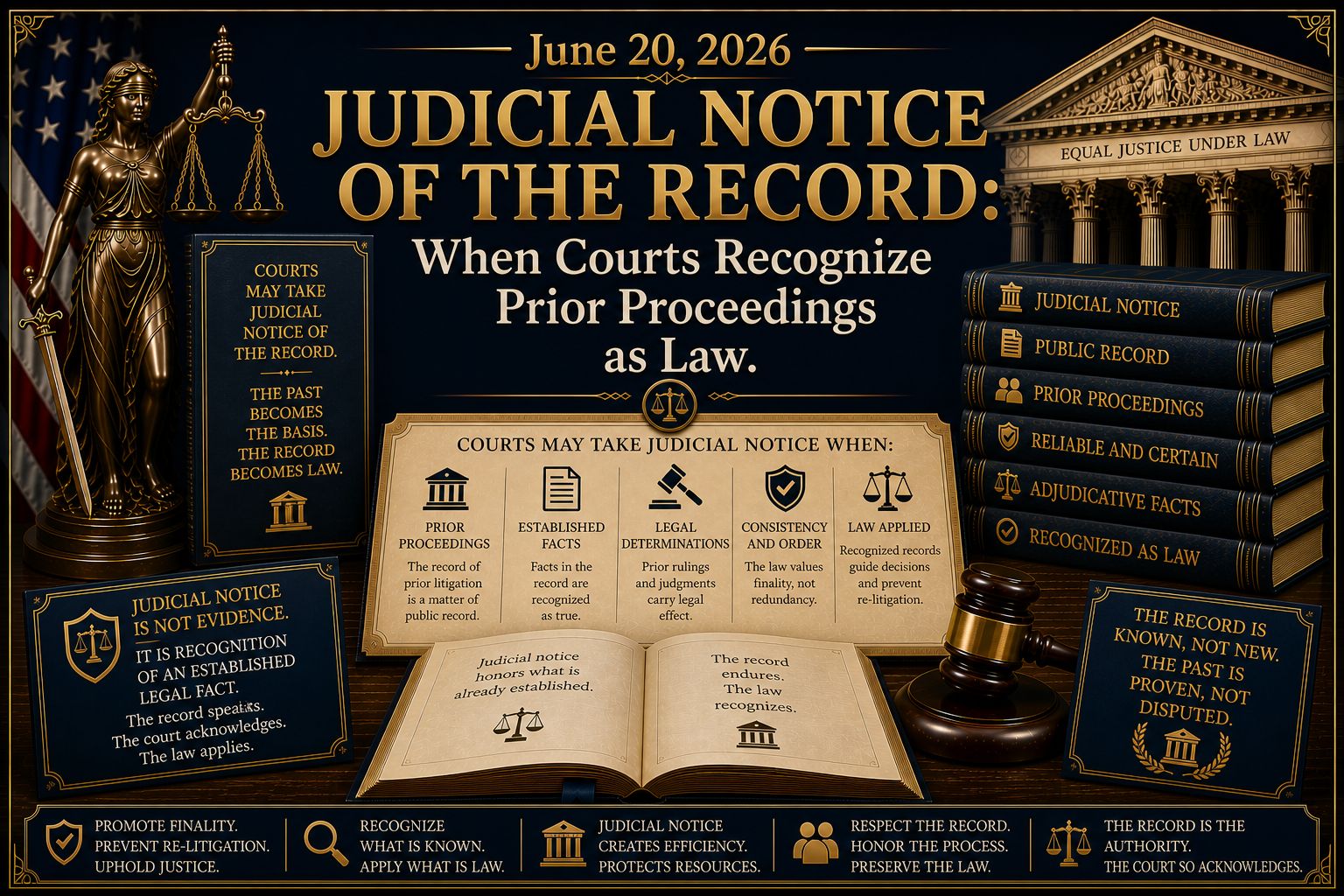
Part IX — Judicial Notice of the Record: When Courts Recognize Prior Proceedings as Law
As legal proceedings accumulate over time, courts are often called upon to recognize not only facts, but also prior records, judgments, and proceedings. The doctrine of judicial notice of the record allows courts to acknowledge the existence and contents of prior proceedings without requiring formal re-proof.
Through this doctrine, the record extends its influence beyond a single case, becoming a recognized source of law and fact in subsequent proceedings.
—
I. The Word: Judicial Notice
Etymology
The term judicial notice derives from:
judicial — from Latin judicium (judgment)
notice — from Latin notitia (knowledge)
Thus, judicial notice refers to knowledge recognized by the court in the exercise of its authority.
—
Black’s Law Dictionary
> Judicial Notice: “A court’s acceptance of a fact as true without requiring formal proof.”
This doctrine allows courts to rely upon established and verifiable information.
—
II. Judicial Notice of Records
Courts may take notice of:
• their own records in the same case
• records from related proceedings
• public records and prior judgments
• official government documents
This allows courts to recognize prior determinations without duplicating proof.
—
III. Purpose of Judicial Notice of the Record
This doctrine serves several important functions.
Efficiency
Avoids unnecessary repetition of evidence.
Consistency
Ensures that courts respect prior determinations.
Continuity
Allows legal proceedings to build upon established records.
—
IV. Judicial Recognition
Courts have recognized the ability to take notice of prior records.
—
United States v. Wilson (1833)
The Supreme Court of the United States acknowledged the importance of recognizing official records within judicial proceedings.
—
Brown v. Board of Education (1954)
The Court considered broader historical and social context in evaluating constitutional questions, illustrating the recognition of established facts and records.
—
V. Relationship to Res Judicata and Estoppel
Judicial notice of the record complements earlier doctrines:
• Res judicata bars re-litigation of decided matters
• Estoppel prevents inconsistent positions
• Judicial notice allows courts to recognize those prior determinations
Together, they ensure continuity and authority of the record.
—
VI. International Recognition
International legal systems also recognize prior proceedings and official records.
Examples include principles found in:
International Covenant on Civil and Political Rights (1966)
Universal Declaration of Human Rights (1948)
These instruments emphasize fair procedures and recognition of lawful determinations.
—
VII. Scriptural Reflections on Knowledge and Record
Sacred texts emphasize recognition of truth and established knowledge.
—
The Holy Bible
Ecclesiastes 1:9
> “There is no new thing under the sun.”
John 8:32
> “You shall know the truth.”
—
The Qur’an
Surah Al-Isra (17:14)
> “Read your record.”
Surah Al-Hujurat (49:6)
> “Verify it.”
These passages reflect acknowledgment and verification of established facts.
—
VIII. Universal Law Insight
Across legal traditions, courts have recognized that established records and prior proceedings should not be ignored. Judicial notice allows courts to incorporate existing knowledge into current proceedings, preserving consistency and efficiency.
—
IX. Practical Implication
When invoking judicial notice of the record, it is important to:
1. identify the specific record or proceeding
2. demonstrate its relevance to the current matter
3. show that it is reliable and verifiable
4. ensure it is properly referenced within the record
These steps allow courts to recognize prior records without requiring redundant proof.
—
Closing Principle
What has been recorded may be recognized.
What is recognized may guide judgment.
Through judicial notice, the record speaks beyond its original proceeding and informs the law that follows.
—
Next Article in the Supreme Record Series
Part X — The Perpetual Record: Law Preserved Beyond Time


Leave a Reply