

Proper Status, Lawful Standing & Legal Representation
Proceeding Lawfully for the Record
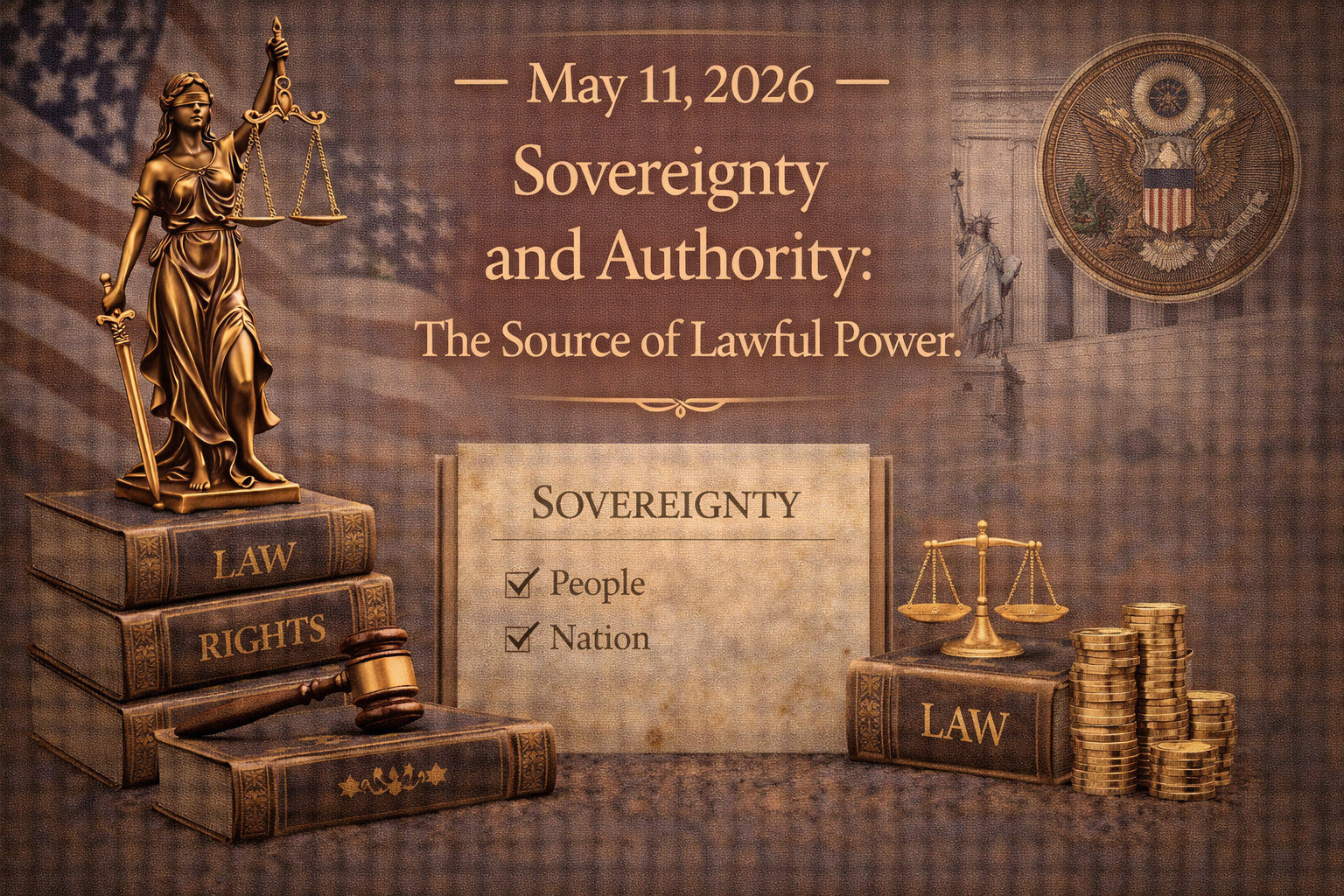
Part XVIII — Sovereignty and Authority: The Source of Lawful Power
Every legal system must identify the source of its authority. Courts may interpret laws, and governments may enact statutes, but behind these institutions lies the foundational question of sovereignty—the ultimate power from which law derives its legitimacy.
Sovereignty determines who or what holds the highest governing authority within a political and legal system. Understanding sovereignty helps clarify how courts exercise jurisdiction and how laws obtain binding force.
—
I. The Word: Sovereignty
Etymology
The word sovereign derives from the Old French soverain, meaning supreme or highest authority.
The deeper Latin root superanus means above or superior.
Historically, sovereignty referred to the highest governing authority within a territory or political community.
—
Black’s Law Dictionary
> Sovereignty: “The supreme political authority of an independent state.”
Sovereignty identifies the ultimate source from which governmental powers originate.
—
II. Popular Sovereignty
Modern constitutional systems often recognize the doctrine of popular sovereignty.
Black’s Law Dictionary
> Popular Sovereignty: “The principle that the ultimate authority of government resides in the people.”
Under this doctrine, governmental institutions derive authority from the collective consent of the governed.
—
III. Constitutional Expression of Sovereignty
The principle of popular sovereignty is reflected in the opening words of the United States Constitution:
> “We the People of the United States… do ordain and establish this Constitution.”
This language expresses the idea that governmental authority originates with the people who establish the constitutional framework.
—
IV. Judicial Recognition of Sovereignty
Courts have addressed the concept of sovereignty in several important decisions.
—
Chisholm v. Georgia (1793)
The Supreme Court of the United States recognized that the Constitution was established by the people rather than by the states alone.
—
Yick Wo v. Hopkins (1886)
The Court emphasized that governmental authority must be exercised consistently with principles of justice and equality under law.
—
V. Sovereignty and Delegated Authority
Within constitutional systems, sovereignty may be understood as delegated authority exercised through governmental institutions.
These institutions include:
• legislative bodies that create laws
• executive authorities that administer laws
• courts that interpret and apply laws
Each branch operates within powers defined by the constitutional framework.
—
VI. Scriptural Reflections on Authority
Sacred texts frequently address the concept of authority and stewardship.
—
The Holy Bible
Proverbs 29:2
> “When the righteous are in authority, the people rejoice.”
Romans 13:1
> “The powers that be are ordained.”
These passages reflect the importance of lawful authority exercised with justice.
—
The Qur’an
Surah Al-Baqarah (2:30)
> “Indeed, I will place upon the earth a successive authority.”
Surah An-Nisa (4:58)
> “Allah commands you to render trusts to whom they are due.”
These verses emphasize responsibility and fairness in authority.
—
VII. Universal Law Insight
Across legal traditions and philosophical systems, sovereignty provides the foundation upon which legal authority rests. Without a recognized source of authority, laws would lack legitimacy and enforceability.
Sovereignty therefore serves as the origin point of legal power within a political system.
—
VIII. Practical Implication
Understanding sovereignty clarifies:
1. how governments obtain authority
2. why constitutional limits exist
3. how courts derive jurisdiction
These principles ensure that governmental power operates within defined boundaries.
—
Closing Principle
Authority must have a source.
Sovereignty identifies the foundation from which lawful power arises and through which legal systems maintain order and justice.
—
Next Article in the Series
Part XIX — Notice and Proclamation: Communicating Law to the Public


Leave a Reply