

Proper Status, Lawful Standing & Legal Representation
Proceeding Lawfully for the Record
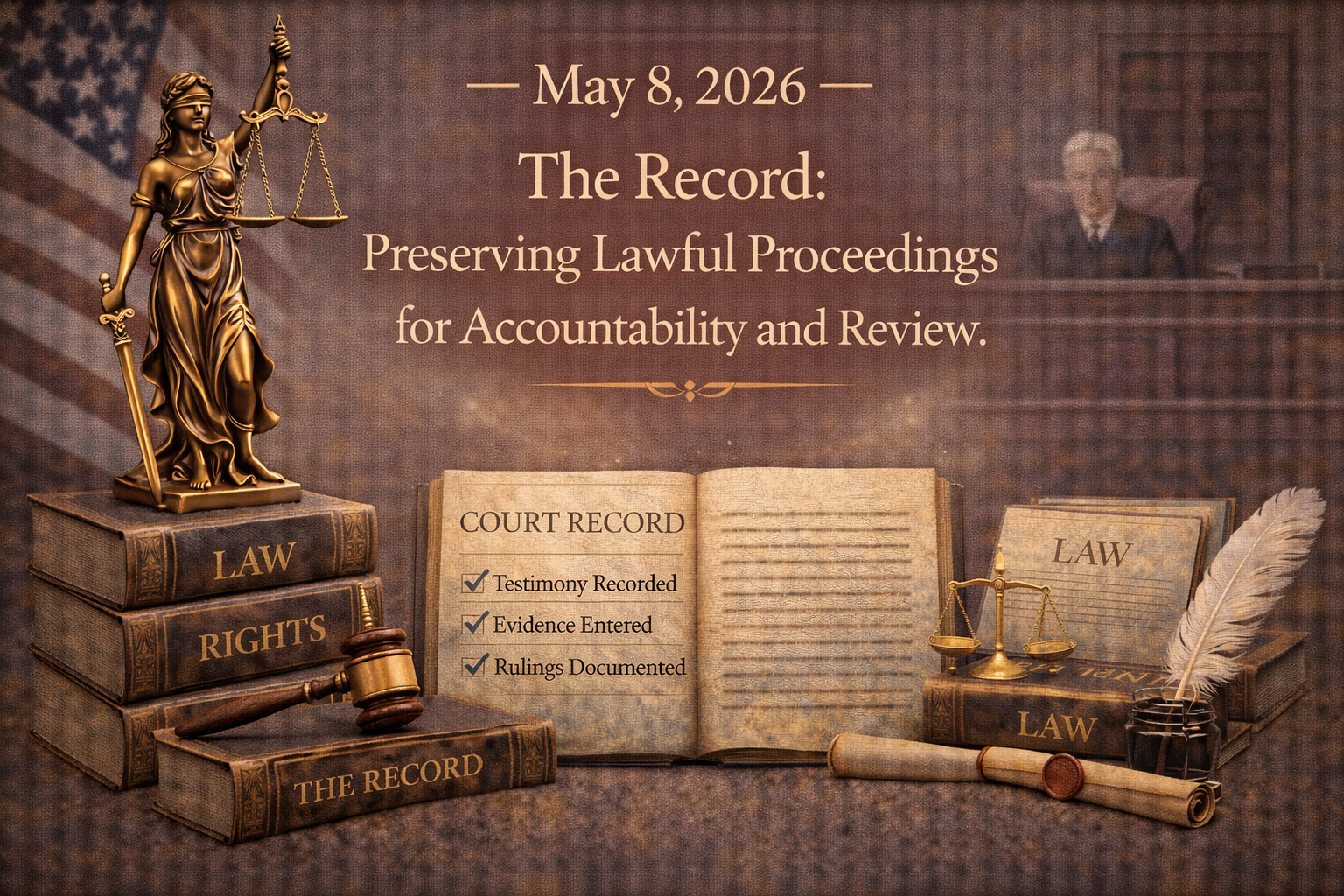
Part XV — The Record: Preserving Lawful Proceedings for Accountability and Review
In every legal system, the authority of judicial proceedings depends upon the record. The record preserves pleadings, evidence, rulings, and judgments so that proceedings remain verifiable and reviewable. Without a reliable record, courts could not ensure transparency, fairness, or accountability.
The concept of the record therefore plays a central role in lawful proceedings and in the ability of appellate courts to review decisions.
—
I. The Word: Record
Etymology
The word record derives from the Latin recordari, meaning to remember or call back to mind.
It combines:
re- — again
cor / cordis — heart
Originally, the term referred to bringing something back into memory. Over time it came to signify written documentation preserving events and decisions.
—
Black’s Law Dictionary
> Record: “The official report of the proceedings in a case, including filed papers, exhibits, and transcripts.”
The record serves as the authoritative documentation of legal proceedings.
—
II. Court of Record
Certain courts are designated as courts of record, meaning that their proceedings are permanently preserved.
Black’s Law Dictionary
> Court of Record: “A court whose acts and proceedings are enrolled for perpetual memory and testimony.”
The phrase perpetual memory reflects the purpose of legal records—to preserve proceedings so that they may be reviewed or enforced later.
—
III. Components of the Record
The court record typically includes:
• pleadings and complaints
• motions and responses
• transcripts of hearings or trials
• documentary evidence
• judicial rulings and orders
• final judgments
These materials form the foundation for appellate review.
—
IV. Record on Appeal
When a case is appealed, the higher court examines the record from the lower court.
Black’s Law Dictionary
> Record on Appeal: “The materials from the trial court that an appellate court reviews.”
Appellate courts rely on this documentation to determine whether legal errors occurred.
—
V. Judicial Recognition of the Importance of Records
Courts frequently emphasize the necessity of a proper record.
—
United States v. Morgan (1939)
The Supreme Court of the United States recognized that administrative and judicial decisions must be supported by an adequate record allowing courts to evaluate the legality of governmental actions.
—
Goldberg v. Kelly (1970)
The Court emphasized that due process requires fair procedures and documentation to ensure meaningful review.
—
VI. Scriptural Reflections on Records and Accountability
Sacred texts often describe the concept of records documenting human actions.
—
The Holy Bible
Malachi 3:16
> “A book of remembrance was written before him.”
Revelation 20:12
> “And the books were opened… and the dead were judged out of those things which were written in the books.”
These passages emphasize the idea of recorded actions leading to judgment.
—
The Qur’an
Surah Al-Isra (17:13–14)
> “Every human being’s record We have fastened to his neck… Read your record.”
Surah Al-Kahf (18:49)
> “The record will be placed, and you will see the guilty fearful of what is in it.”
These verses emphasize documentation and accountability.
—
VII. Universal Law Insight
Across legal traditions and moral teachings, records preserve the memory of actions and decisions. Documentation ensures that justice remains transparent and that authorities may be held accountable for their rulings.
Records therefore serve as the institutional memory of the legal system.
—
VIII. Practical Implication
When proceeding lawfully before a court, parties should ensure that:
1. filings are properly documented
2. evidence is entered into the record
3. objections and rulings are preserved
4. transcripts accurately reflect proceedings
A clear record protects the rights of the parties and allows meaningful review by higher courts.
—
Closing Principle
Law is spoken in the courtroom but preserved in the record.
Through written documentation, legal systems ensure that justice remains transparent, reviewable, and accountable across time.
—
Next Article in the Series
Part XVI — Enforcement: How Judgments Are Carried Into Effect


Leave a Reply