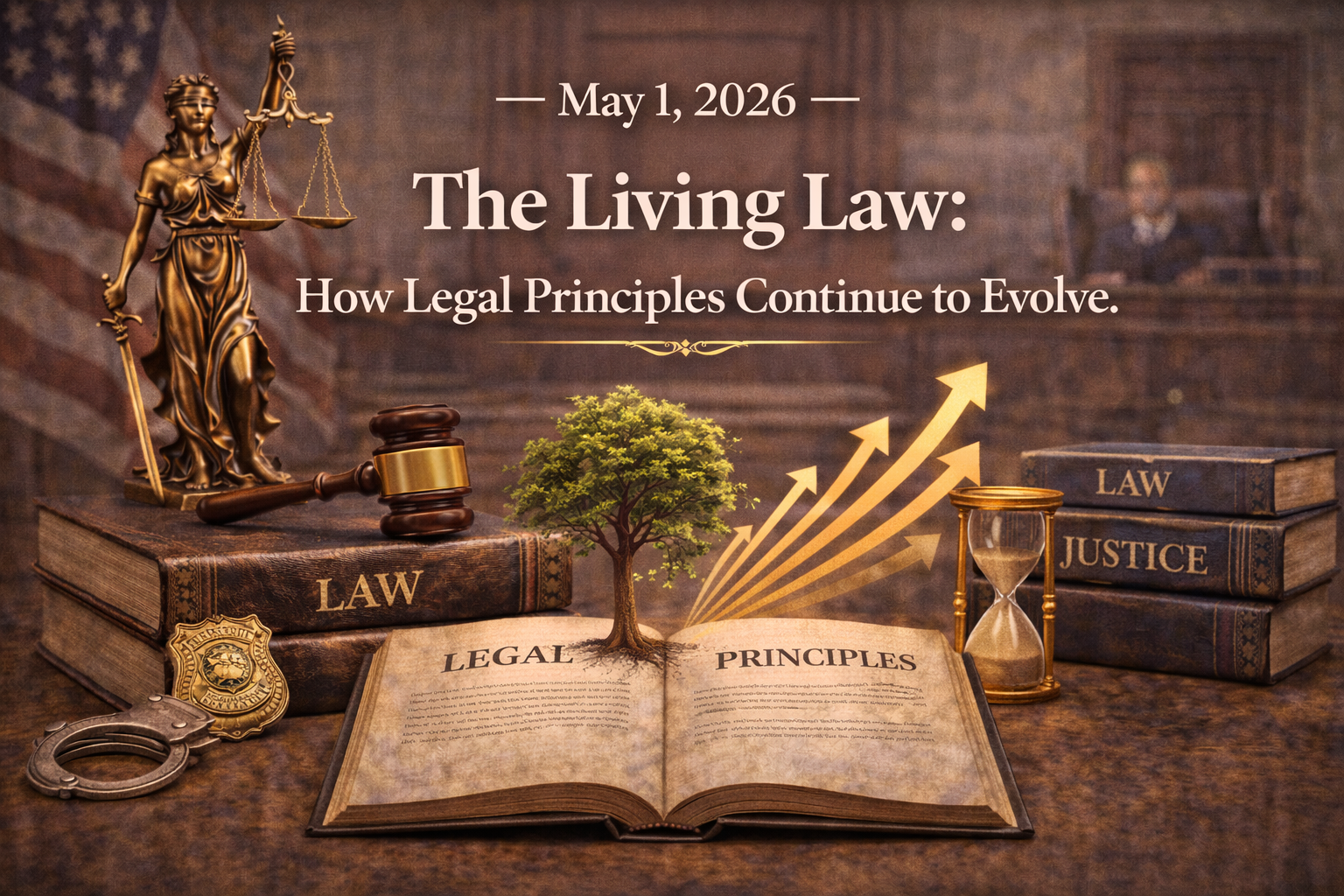


Universal Law & Constitutional Order Series
Part XXVI — The Living Law: How Legal Principles Continue to Evolve
Law is not static. While foundational principles endure across generations, the interpretation and application of those principles evolve as societies change. Courts, legislatures, and legal scholars continually interpret law in response to new circumstances, technologies, and social conditions. This dynamic process has often been described as the living law.
The concept of a living legal system reflects the balance between continuity and adaptation—preserving foundational principles while allowing law to respond to new realities.
—
I. The Word: Living
Etymology
The word living derives from the Old English libban, meaning to remain alive or continue in existence.¹
In legal discourse, the phrase living law suggests that law remains active and evolving rather than fixed or inert.
—
II. The Word: Law
Etymology
The English word law originates from Old Norse lagu, meaning that which is laid down or established.²
The Indo-European root legh- means to lay or place.
Law therefore refers to principles established within a community to govern conduct and resolve disputes.
—
III. Legal Evolution
Legal systems adapt through several mechanisms.
Judicial Interpretation
Courts interpret statutes and constitutional provisions in light of changing circumstances.
Legislative Action
Legislatures enact new statutes responding to emerging issues.
Custom and Practice
Legal doctrines may evolve through long-standing practice and social developments.
These mechanisms allow law to remain relevant and effective within changing societies.
—
IV. Judicial Recognition of Legal Evolution
Courts have recognized that constitutional interpretation may evolve as society changes.
—
Missouri v. Holland (1920)
The Supreme Court of the United States acknowledged that constitutional interpretation may consider evolving national circumstances.
—
Trop v. Dulles (1958)
The Court observed that constitutional interpretation may reflect “evolving standards of decency” in society.
This decision illustrates how legal principles may adapt while remaining grounded in constitutional authority.
—
V. Continuity and Stability
While law evolves, legal systems also preserve stability through enduring principles such as:
constitutional supremacy
due process
equal protection
rule of law
These principles maintain continuity across generations.
—
VI. Scriptural Reflections on Enduring Principles
Sacred texts often express the idea that moral principles endure even as human societies change.
—
The Holy Bible
Ecclesiastes 3:1
> “To every thing there is a season.”³
Matthew 24:35
> “Heaven and earth shall pass away, but my words shall not pass away.”⁴
These passages reflect the balance between changing circumstances and enduring principles.
—
The Qur’an
Surah Ar-Ra’d (13:11)
> “Indeed, Allah will not change the condition of a people until they change what is within themselves.”⁵
Surah Al-Anbiya (21:107)
> “We have not sent you except as a mercy to the worlds.”⁶
These verses emphasize both human responsibility and enduring guidance.
—
VII. Universal Law Insight
Across civilizations, law evolves as societies develop new knowledge, technologies, and social relationships. Yet legal systems remain grounded in enduring principles of justice, fairness, and accountability.
This balance between adaptation and continuity allows law to remain effective across generations.
—
VIII. Practical Implication
Modern legal systems adapt to new challenges such as:
digital communication
emerging technologies
global commerce
international cooperation
Through legislative action and judicial interpretation, legal institutions address these evolving realities.
—
Closing Principle
Law lives through interpretation and application.
While societies change, the enduring principles of justice continue to guide the evolution of legal systems.
—
Footnotes
1. Oxford English Dictionary, entry for “live,” from Old English libban.
2. Oxford English Dictionary, entry for “law,” from Old Norse lagu.
3. The Holy Bible, Ecclesiastes 3:1 (KJV).
4. The Holy Bible, Matthew 24:35 (KJV).
5. The Qur’an, Surah Ar-Ra’d 13:11.
6. The Qur’an, Surah Al-Anbiya 21:107.
—
Final Reflection of the Extended Series
From the origins of law and jurisdiction to sovereignty, justice, mercy, and evolving legal systems, this extended series has explored the foundational principles that shape legal order.
Together these concepts illustrate how societies strive to maintain:
justice
peace
accountability
lawful governance
Through institutions, records, and shared principles, law continues to guide human communities across generations..


Leave a Reply