

Proper Status, Lawful Standing & Legal Representation
How to Proceed Lawfully for the Record
—
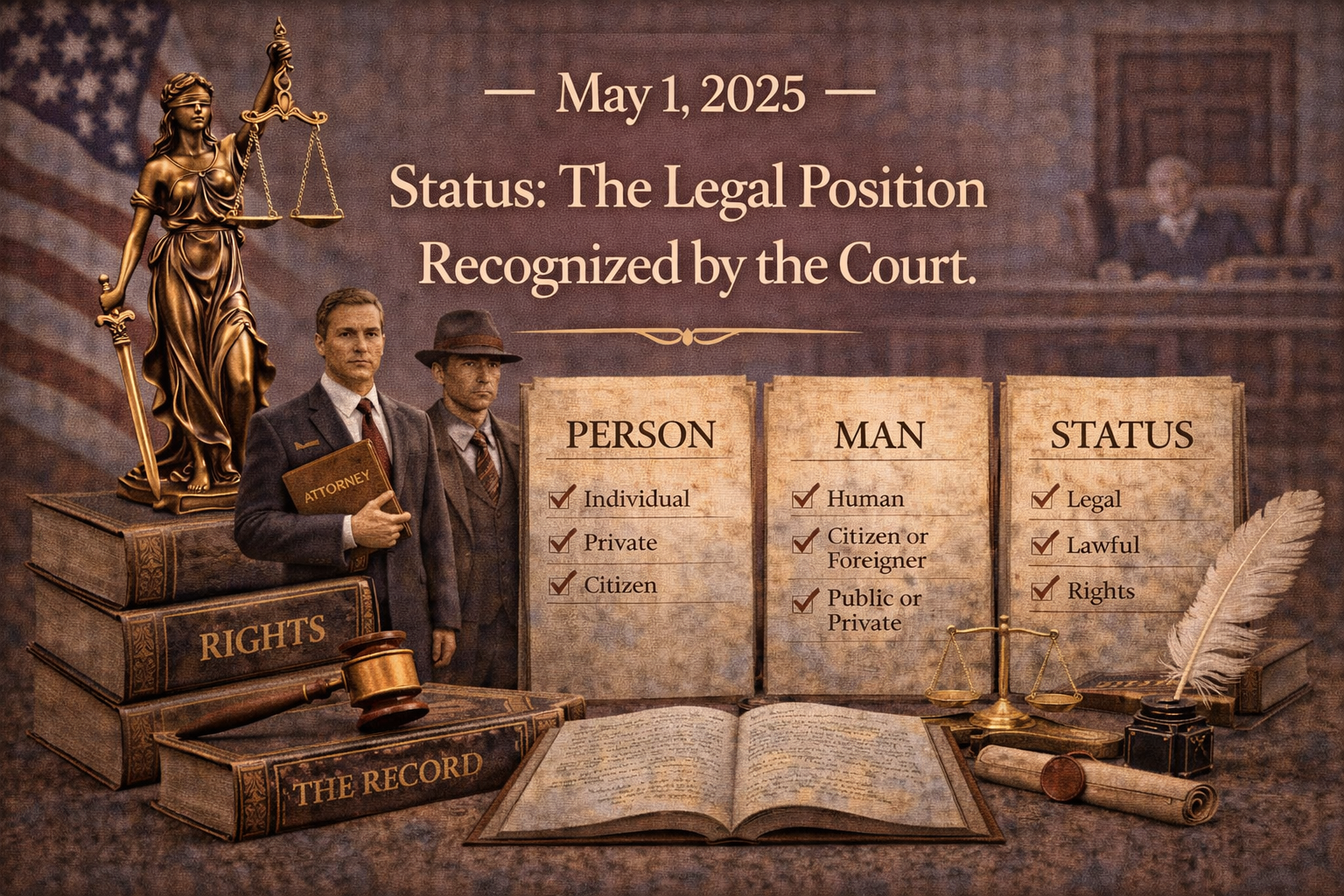
Part I — Status: The Legal Position Recognized by the Court
Before a court may hear a claim or controversy, it must determine the status of the parties appearing before it. Status defines the legal relationship between an individual and the legal system.
Without a recognized status, the court cannot determine jurisdiction, rights, or obligations.
—
Etymology
The word status derives from the Latin status, meaning condition, position, or standing.
It originates from the Latin verb stare, meaning to stand.
Thus, status literally refers to the position in which one stands in relation to law.
—
Black’s Law Dictionary
> Status: “A person’s legal condition or position in relation to the law.”
Legal status may determine:
• citizenship
• residency
• corporate identity
• marital status
• legal capacity
These classifications influence how courts interpret rights and obligations.
—
Why Status Matters
Courts require identification of the parties involved before determining jurisdiction. Status allows the court to establish:
• who the parties are
• what rights may be asserted
• which laws apply
Without this clarification, the court cannot proceed.
—
Closing Principle
Status defines who the law recognizes within a legal proceeding.
—
Part II — Standing: The Right to Invoke the Court’s Authority
Once status is established, the next question concerns standing.
Standing determines whether a party possesses the legal right to bring a claim before the court.
—
Etymology
The word standing derives from Old English standan, meaning to stand or remain in position.
In legal usage, standing refers to the recognized position allowing a party to appear before a tribunal.
—
Black’s Law Dictionary
> Standing: “A party’s right to make a legal claim or seek judicial enforcement of a duty or right.”
Standing ensures that courts address actual disputes rather than abstract questions.
—
Elements of Standing
Courts typically evaluate three elements:
Injury
A legally recognizable harm must exist.
Causation
The harm must be connected to the conduct challenged.
Redressability
The court must be able to provide relief.
—
Judicial Recognition
Standing doctrine has been clarified in
Lujan v. Defenders of Wildlife (1992).
The Supreme Court of the United States explained that courts may only decide actual cases or controversies.
—
Closing Principle
Standing determines who may invoke the authority of the court.
—
Part III — Capacity: The Ability to Act in Law
Even when status and standing exist, a party must possess capacity to act within the legal system.
—
Etymology
The word capacity derives from the Latin capacitas, meaning ability or capability.
—
Black’s Law Dictionary
> Capacity: “The legal ability of a person to enter into binding legal relations.”
Capacity determines whether a party may:
• file legal claims
• enter contracts
• appear in court
• authorize representation
—
Legal Disabilities
Certain conditions may limit capacity, including:
• minority (age)
• legal incompetence
• guardianship
These limitations protect individuals who cannot fully manage legal obligations.
—
Closing Principle
Capacity determines whether a person may act within the legal system.
—
Part IV — Representation: Acting Through an Authorized Advocate
Parties appearing before courts often act through legal representatives.
Representation allows individuals to assert claims and defend rights through trained advocates.
—
Etymology
The word represent derives from the Latin repraesentare, meaning to present again or act in place of another.
—
Black’s Law Dictionary
> Attorney: “A person authorized to act on behalf of another in legal matters.”
Representation may occur through:
• attorneys
• legal guardians
• authorized agents
—
Legal Authority of Representation
Representation must be properly authorized through:
• power of attorney
• formal appointment
• legal representation agreements
Without authorization, representation may not be recognized by the court.
—
Closing Principle
Representation allows parties to exercise legal rights through authorized advocates.
—
Part V — Proceeding for the Record
Courts rely upon records documenting proceedings, evidence, and decisions.
To proceed lawfully, actions must be properly entered into the record.
—
Etymology
The word record derives from Latin recordari, meaning to remember or recall.
—
Black’s Law Dictionary
> Record: “The official report of the proceedings in a case.”
The court record includes:
• pleadings
• motions
• evidence
• transcripts
• judgments
—
Courts of Record
Black’s Law Dictionary
> Court of Record: “A court whose proceedings are permanently recorded for memory and testimony.”
This ensures transparency and reviewability.
—
Closing Principle
Legal proceedings obtain authority through documentation within the official record.
—
Part VI — Judicial Notice and Status on the Record
Courts may acknowledge certain facts without requiring additional proof.
This doctrine is known as judicial notice.
—
Black’s Law Dictionary
> Judicial Notice: “A court’s acceptance of a fact as true without requiring formal proof.”
Judicial notice may apply to:
• statutes
• public records
• historical facts
• widely recognized information
—
Closing Principle
Judicial notice allows courts to recognize established facts within the record.
—
Series Summary
This series establishes the fundamental legal sequence:
1. Status — Who the law recognizes
2. Standing — Who may bring a claim
3. Capacity — Who may act legally
4. Representation — Who may act on another’s behalf
5. Record — How proceedings are preserved
Together these elements form the structure through which courts administer justice.
—
Part VII — Notice and Opportunity to Be Heard
Before a court may exercise authority over a person or matter, the principles of justice require that the parties receive notice and an opportunity to be heard. These requirements form part of the doctrine known as due process of law, ensuring fairness in judicial proceedings.
Without proper notice, a court may lack jurisdiction to proceed against a party whose rights may be affected.
—
I. The Word: Notice
Etymology
The word notice derives from the Latin notitia, meaning knowledge or awareness.
Its root comes from noscere, meaning to know.
Historically, notice referred to the act of informing a person of facts or circumstances that require attention or response.
—
Black’s Law Dictionary
> Notice: “Legal notification required by law or agreement, or the formal communication of information.”
Notice ensures that individuals are aware of legal proceedings affecting their rights or obligations.
—
II. Types of Notice
Legal doctrine recognizes several forms of notice.
Actual Notice
Actual notice occurs when a person receives direct knowledge of a legal matter.
Examples include:
• service of legal documents
• written communication
• personal delivery of court summons
—
Constructive Notice
Constructive notice arises when information is publicly recorded or available, even if a person has not personally received it.
Black’s Law Dictionary
> Constructive Notice: “Notice arising by presumption of law from the existence of facts that a person had a duty to inquire about.”
Examples include:
• recorded property interests
• published laws
• public records
—
III. Service of Process
Courts commonly deliver notice through service of process.
Black’s Law Dictionary
> Service of Process: “The formal delivery of a writ, summons, or other legal process.”
Service of process informs parties that legal proceedings have been initiated and provides an opportunity to respond.
—
IV. Judicial Recognition
The importance of notice in legal proceedings was emphasized in
Mullane v. Central Hanover Bank & Trust Co. (1950).
The Supreme Court of the United States held that notice must be reasonably calculated to inform interested parties.
This principle protects fairness within the legal system.
—
V. Opportunity to Be Heard
Notice alone is not sufficient. Individuals must also have an opportunity to present their position before the court.
Black’s Law Dictionary
> Hearing: “A judicial session in which evidence and arguments are presented.”
Hearings allow courts to evaluate:
• evidence
• legal arguments
• witness testimony
—
VI. Scriptural Reflection
Sacred texts frequently emphasize fairness and hearing before judgment.
The Holy Bible
Proverbs 18:13
> “He that answereth a matter before he heareth it, it is folly and shame.”
—
The Qur’an
Surah Al-Hujurat (49:6)
> “If a wicked person brings you news, verify it.”
These teachings emphasize the principle that judgment requires careful examination of facts.
—
VII. Universal Law Insight
Across legal systems and moral traditions, justice requires that individuals receive both:
• notice of proceedings, and
• a fair opportunity to respond.
These principles protect individuals from arbitrary judgment and ensure that legal authority operates within the bounds of fairness.
—
Closing Principle
Lawful proceedings begin with notice.
Justice requires that every party have an opportunity to be heard before judgment is rendered.
—


Leave a Reply