

Universal Law & Constitutional Order Series
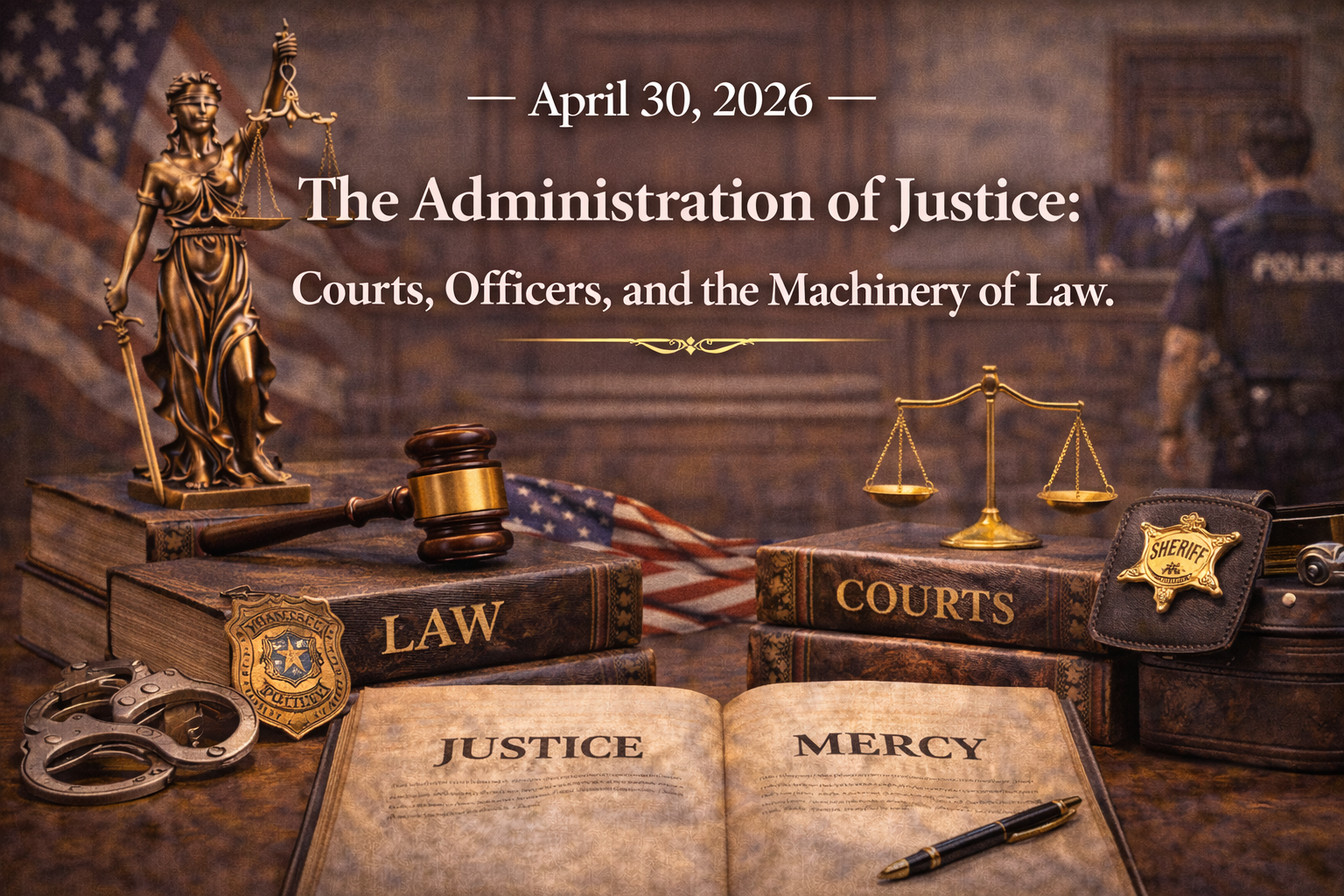
Part XXV — The Administration of Justice: Courts, Officers, and the Machinery of Law
Law does not function in theory alone. For legal principles to operate within society, they must be administered through institutions and officers responsible for interpreting, applying, and enforcing the law. This system of institutions is often described as the administration of justice.
Courts, judges, clerks, attorneys, and law enforcement officers each play roles within this framework. Together they form the institutional structure through which legal disputes are resolved and rights are protected.
Understanding the administration of justice requires examining the etymology of the terms, their definitions in Black’s Law Dictionary, their recognition in judicial precedent, and their reflection in sacred teachings regarding fair judgment.
—
I. The Word: Administration
Etymology
The word administration derives from the Latin administrare, meaning to manage, direct, or serve.¹
The root combines:
ad — toward
ministrare — to serve or assist
Historically, administration referred to the management and execution of responsibilities within an organized system.
—
Black’s Law Dictionary (11th ed.)
> Administration of Justice: “The maintenance of right within a political community through the physical force of the state.”²
This definition reflects the institutional role of courts and legal officers in maintaining lawful order.
—
II. The Word: Court
Etymology
The word court derives from the Latin cohors, meaning an enclosed place or assembly.³
Through Old French cour, the term came to describe a place where judicial authority is exercised.
—
Black’s Law Dictionary (11th ed.)
> Court: “A governmental body consisting of one or more judges who sit to adjudicate disputes and administer justice.”⁴
Courts function as the central institutions where legal disputes are resolved.
—
III. Judicial Officers
Several officers assist in the operation of courts.
—
Judge
A judge presides over legal proceedings and renders decisions.
Black’s Law Dictionary
> Judge: “A public official appointed or elected to decide legal disputes.”⁵
—
Clerk of Court
Clerks maintain records and manage court documentation.
Black’s Law Dictionary
> Clerk: “An officer responsible for keeping records and performing administrative duties of a court.”⁶
—
Attorney
Attorneys represent parties in legal proceedings.
Black’s Law Dictionary
> Attorney: “A person authorized to act for another in legal matters.”⁷
—
IV. Judicial Process
The administration of justice generally follows structured procedures.
Typical stages include:
1. filing of claims or complaints
2. service of notice
3. presentation of evidence
4. judicial determination
5. entry of judgment
6. enforcement or appeal
These procedures ensure that disputes are resolved through orderly and fair processes.
—
V. Judicial Recognition of Institutional Justice
Courts frequently emphasize the importance of maintaining fair judicial institutions.
—
Tumey v. Ohio (1927)
The Supreme Court of the United States held that judicial proceedings must be conducted by impartial judges, reinforcing the importance of fairness in judicial administration.
—
In re Murchison (1955)
The Court emphasized that due process requires a fair tribunal and unbiased adjudication.
—
VI. Scriptural Reflections on Justice and Governance
Sacred texts frequently address the responsibilities of judges and authorities.
—
The Holy Bible
Deuteronomy 16:18
> “Judges and officers shalt thou make… and they shall judge the people with just judgment.”⁸
Proverbs 21:3
> “To do justice and judgment is more acceptable.”⁹
These passages emphasize the moral responsibility of those administering justice.
—
The Qur’an
Surah An-Nisa (4:58)
> “When you judge between people, judge with justice.”¹⁰
Surah Al-Ma’idah (5:42)
> “If you judge, judge between them with justice.”¹¹
These verses highlight the importance of fairness in judicial authority.
—
VII. Universal Law Insight
Legal institutions exist to transform legal principles into practical governance. Courts and officers ensure that disputes are resolved through established procedures rather than through private conflict or coercion.
The administration of justice therefore represents the operational system through which law functions within society.
—
VIII. Practical Implication
For legal systems to function effectively, they must maintain:
independent courts
accurate records
impartial decision-making
clear procedural rules
These elements allow societies to resolve disputes and maintain confidence in legal institutions.
—
Closing Principle
Law establishes principles.
Courts apply those principles.
Justice emerges when institutions administer the law with fairness and integrity.
—
Footnotes
1. Oxford English Dictionary, entry for “administration,” from Latin administrare.
2. Black’s Law Dictionary, 11th ed. (2019), definition discussing administration of justice.
3. Oxford English Dictionary, entry for “court,” from Latin cohors.
4. Black’s Law Dictionary, 11th ed., definition of “court.”
5. Black’s Law Dictionary, 11th ed., definition of “judge.”
6. Black’s Law Dictionary, 11th ed., definition of “clerk.”
7. Black’s Law Dictionary, 11th ed., definition of “attorney.”
8. The Holy Bible, Deuteronomy 16:18 (KJV).
9. The Holy Bible, Proverbs 21:3 (KJV).
10. The Qur’an, Surah An-Nisa 4:58.
11. The Qur’an, Surah Al-Ma’idah 5:42.
—
Next Article in the Extended Series
Part XXVI — The Living Law: How Legal Principles Continue to Evolve
(A concluding reflection on how law adapts across generations while preserving foundational principles.)


Leave a Reply