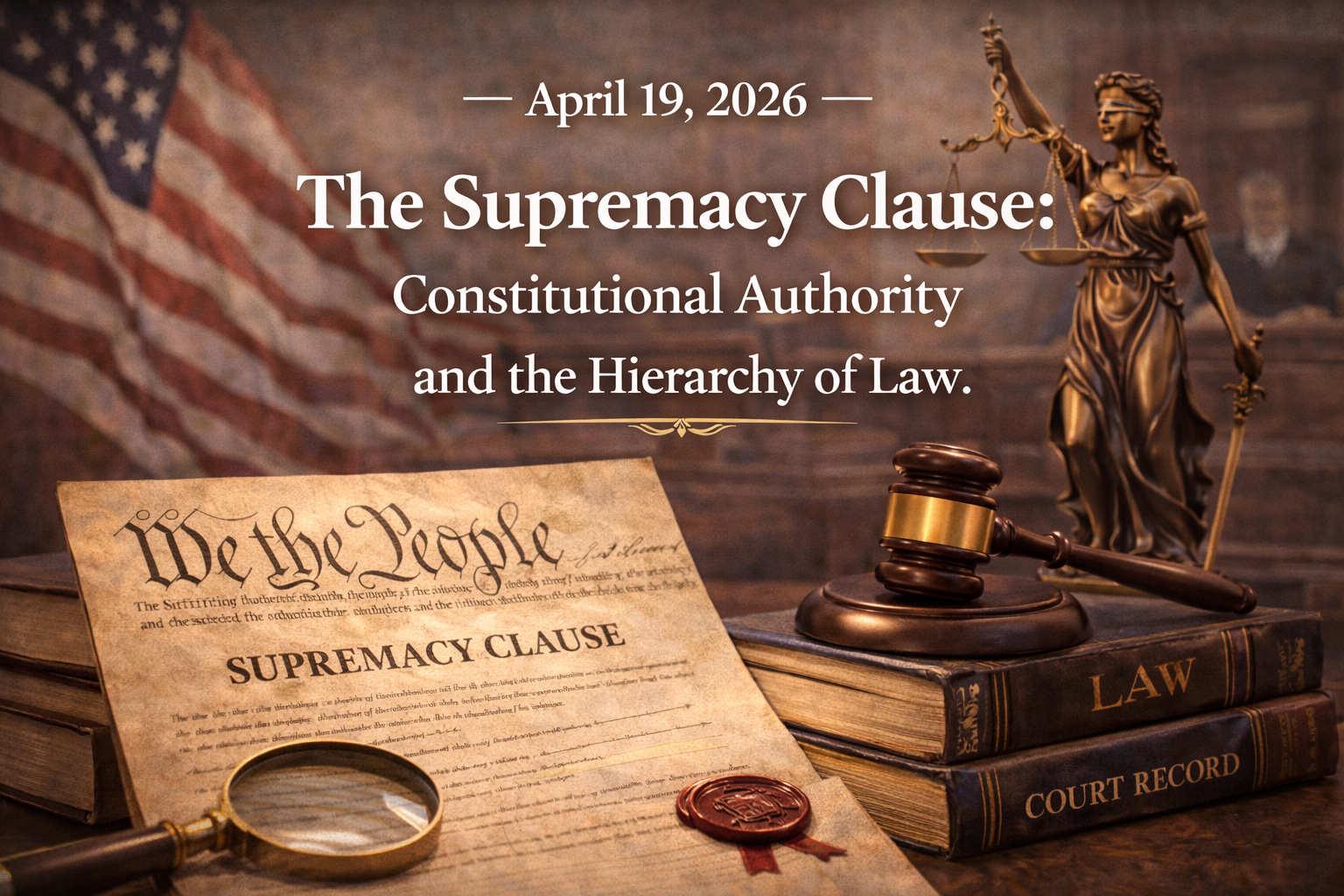


Universal Law & Constitutional Order Series
Part XIII — The Supremacy Clause: Constitutional Authority and the Hierarchy of Law
Legal systems operate through a hierarchy of authority that determines which law governs when multiple sources of law exist. Within the constitutional framework of the United States, this hierarchy is established through the Supremacy Clause.
The Supremacy Clause ensures that the Constitution and laws enacted pursuant to it remain the highest authority within the legal system. Understanding this principle requires examining its etymological roots, definitions in Black’s Law Dictionary, and interpretation by the courts.
—
I. Constitutional Foundation
The Supremacy Clause appears in Article VI, Clause 2 of the United States Constitution.
> “This Constitution, and the Laws of the United States which shall be made in Pursuance thereof… shall be the supreme Law of the Land.”
This clause establishes that:
1. The Constitution is the highest law.
2. Federal statutes enacted under constitutional authority prevail over conflicting state laws.
3. Treaties made under federal authority also carry the force of supreme law.
—
II. The Word: Supremacy
Etymology
The word supreme derives from the Latin supremus, meaning highest, greatest, or most elevated.¹
From this root, supremacy refers to ultimate authority within a hierarchy.
—
Black’s Law Dictionary (11th ed.)
> Supremacy Clause: “The constitutional provision declaring that federal law takes precedence over conflicting state laws.”²
This doctrine ensures that the legal system operates with consistent authority and uniformity.
—
III. Hierarchy of Law
Legal authority within the United States operates through a hierarchy.
1. Constitution
The Constitution serves as the foundational legal authority.
2. Federal Statutes and Treaties
Laws enacted by Congress and treaties made by the federal government.
3. State Constitutions and Laws
State laws must remain consistent with federal constitutional principles.
When conflicts arise, the Supremacy Clause resolves the conflict.
—
IV. Judicial Recognition of the Supremacy Clause
Courts have repeatedly affirmed the authority of the Supremacy Clause.
—
McCulloch v. Maryland (1819)
The Supreme Court of the United States held that states may not interfere with valid federal laws.
Chief Justice John Marshall stated that federal law enacted under the Constitution is supreme within its sphere of authority.
—
Cooper v. Aaron (1958)
The Court reaffirmed that state officials are bound by the Court’s constitutional interpretations, emphasizing the binding nature of federal constitutional law.
—
V. Preemption
Closely related to the Supremacy Clause is the doctrine of preemption.
Black’s Law Dictionary
> Preemption: “The principle that federal law overrides conflicting state law.”³
Preemption may occur when:
Congress explicitly states its intent to override state law
federal regulation occupies an entire field of law
state law conflicts with federal law
—
VI. Scriptural Reflections on Authority and Law
Sacred texts often discuss authority and justice as guiding principles.
—
The Holy Bible
Romans 13:1
> “Let every soul be subject unto the higher powers.”⁴
Ecclesiastes 8:4
> “Where the word of a king is, there is power.”⁵
These passages recognize the existence of ordered authority within society.
—
The Qur’an
Surah An-Nisa (4:59)
> “O you who believe, obey Allah and obey the Messenger and those in authority among you.”⁶
Surah Al-Ma’idah (5:8)
> “Be steadfast for Allah as witnesses in justice.”⁷
These verses emphasize the importance of lawful authority exercised with justice.
—
VII. Universal Law Insight
The concept of supreme authority appears across legal traditions and philosophical systems. Legal hierarchies exist to ensure that conflicts between laws can be resolved in a structured manner.
Within constitutional systems, the Supremacy Clause functions as the mechanism that preserves coherence and stability in the legal order.
—
VIII. Practical Implication
Courts evaluating legal disputes may examine:
whether federal law applies
whether state law conflicts with federal authority
whether federal law preempts state regulation
When such conflicts arise, courts apply the Supremacy Clause to determine which law governs.
—
Closing Principle
Legal systems require a clear hierarchy of authority.
The Supremacy Clause ensures that constitutional law remains the ultimate authority guiding the interpretation and application of law within the United States.
—
Footnotes
1. Oxford English Dictionary, entry for “supreme,” from Latin supremus.
2. Black’s Law Dictionary, 11th ed. (2019), definition of “Supremacy Clause.”
3. Black’s Law Dictionary, 11th ed., definition of “preemption.”
4. The Holy Bible, Romans 13:1 (KJV).
5. The Holy Bible, Ecclesiastes 8:4 (KJV).
6. The Qur’an, Surah An-Nisa 4:59.
7. The Qur’an, Surah Al-Ma’idah 5:8.
—
Next Article in the Extended Series
Part XIV — Status and Capacity: Who the Law Recognizes and Why It Matters


Leave a Reply