

Universal Law & Constitutional Order Series
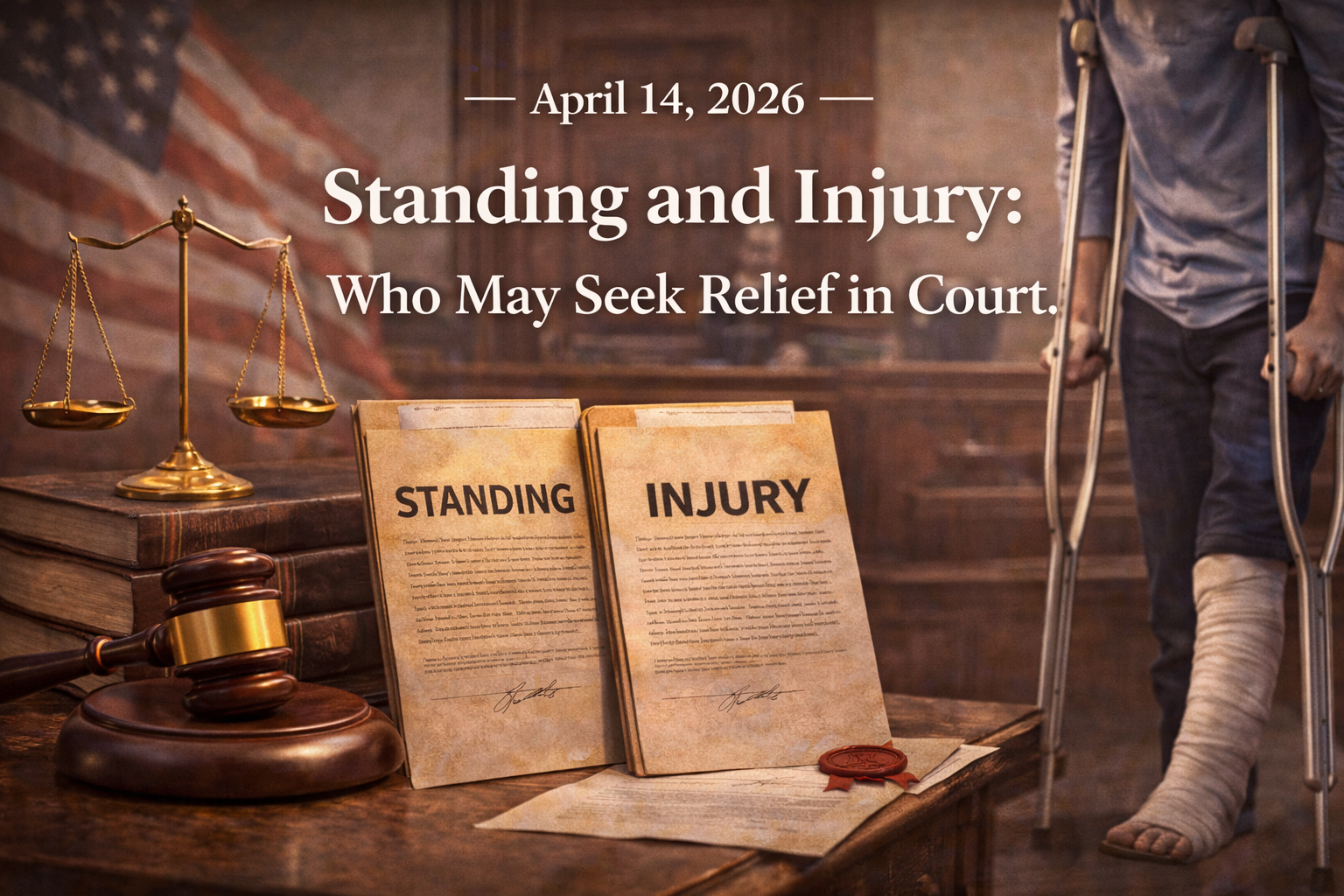
Part VIII — Standing and Injury: Who May Seek Relief in Court
Courts exist to resolve actual disputes between parties with legitimate legal interests. Before a court may exercise its authority, it must determine whether the party bringing the claim has standing. Closely related to this concept is injury, which establishes whether a legal harm has occurred.
Standing and injury function as threshold requirements ensuring that courts adjudicate real controversies rather than hypothetical questions.
To understand these concepts clearly, it is useful to examine their etymological origins, their definitions in Black’s Law Dictionary, and their interpretation in judicial decisions.
—
I. The Word: Standing
Etymology
The word standing derives from the Old English standan, meaning to stand, remain, or be established.¹
In legal usage, the term refers to a party’s recognized position before the court.
—
Black’s Law Dictionary (11th ed.)
> Standing: “A party’s right to make a legal claim or seek judicial enforcement of a duty or right.”²
Standing determines whether a party is entitled to bring a matter before the court.
—
II. Elements of Standing
Courts commonly evaluate standing using three elements.
Injury in Fact
The claimant must demonstrate a concrete and particularized harm.
Causation
The harm must be fairly traceable to the conduct being challenged.
Redressability
The court must be capable of providing a remedy that addresses the injury.
These requirements ensure that courts address actual disputes involving real parties.
—
III. The Word: Injury
Etymology
The word injury derives from the Latin injuria, meaning wrong, injustice, or violation of rights.³
The term combines:
in — not
jus — right or law
Thus, injury historically referred to a violation of a legal right.
—
Black’s Law Dictionary (11th ed.)
> Injury: “Any harm or damage to another’s legal rights.”⁴
An injury may be:
physical
financial
reputational
constitutional
—
IV. Judicial Recognition of Standing
The doctrine of standing has been addressed in numerous court decisions.
—
Lujan v. Defenders of Wildlife (1992)
The Supreme Court of the United States articulated the modern three-part test for standing:
1. injury in fact
2. causation
3. redressability
The Court emphasized that federal courts may decide only actual cases or controversies.
—
Spokeo, Inc. v. Robins (2016)
The Court clarified that a statutory violation alone may not establish standing unless the plaintiff demonstrates a concrete injury.
—
V. Constitutional Foundations
Standing doctrine arises from the “case or controversy” requirement in Article III of the United States Constitution.
This requirement limits federal courts to resolving real disputes rather than abstract policy questions.
—
VI. Scriptural Reflections on Injury and Justice
Sacred texts frequently address the need for justice when harm occurs.
—
The Holy Bible
Exodus 23:1
> “Thou shalt not raise a false report: put not thine hand with the wicked to be an unrighteous witness.”⁵
Isaiah 1:17
> “Seek judgment, relieve the oppressed, judge the fatherless, plead for the widow.”⁶
These passages emphasize the importance of addressing wrongdoing and protecting the injured.
—
The Qur’an
Surah An-Nisa (4:135)
> “Stand firmly for justice, as witnesses for Allah, even if it be against yourselves.”⁷
Surah Al-Ma’idah (5:8)
> “Be steadfast in justice.”⁸
These verses highlight the principle that justice requires truthful recognition of harm and fair judgment.
—
VII. Universal Law Insight
Across legal systems and moral traditions, the recognition of harm plays a central role in the pursuit of justice. Courts serve as institutions where those who have suffered injury may seek lawful remedies.
Standing ensures that only parties with genuine interests invoke the authority of the court, thereby preserving the legitimacy and focus of judicial proceedings.
—
VIII. Practical Implication
Before proceeding with a case, courts typically determine whether:
the claimant has suffered a legally recognized injury
the injury is connected to the defendant’s conduct
the court has authority to provide relief
If standing is absent, the court must dismiss the claim.
—
Closing Principle
Courts exist to resolve real disputes.
Standing identifies who may seek relief, while injury establishes why relief may be warranted.
Together, these principles ensure that judicial authority is exercised only in matters involving genuine legal controversies.
—
Footnotes
1. Oxford English Dictionary, entry for “stand,” from Old English standan.
2. Black’s Law Dictionary, 11th ed. (2019), definition of “standing.”
3. Oxford English Dictionary, entry for “injury,” from Latin injuria.
4. Black’s Law Dictionary, 11th ed., definition of “injury.”
5. The Holy Bible, Exodus 23:1 (KJV).
6. The Holy Bible, Isaiah 1:17 (KJV).
7. The Qur’an, Surah An-Nisa 4:135.
8. The Qur’an, Surah Al-Ma’idah 5:8.
—
Next Article in the Extended Series
Part IX — Remedies and Relief: How Courts Restore Rights and Resolve Injury


Leave a Reply