

Proper Status, Lawful Standing & Legal Representation
Proceeding Lawfully for the Record
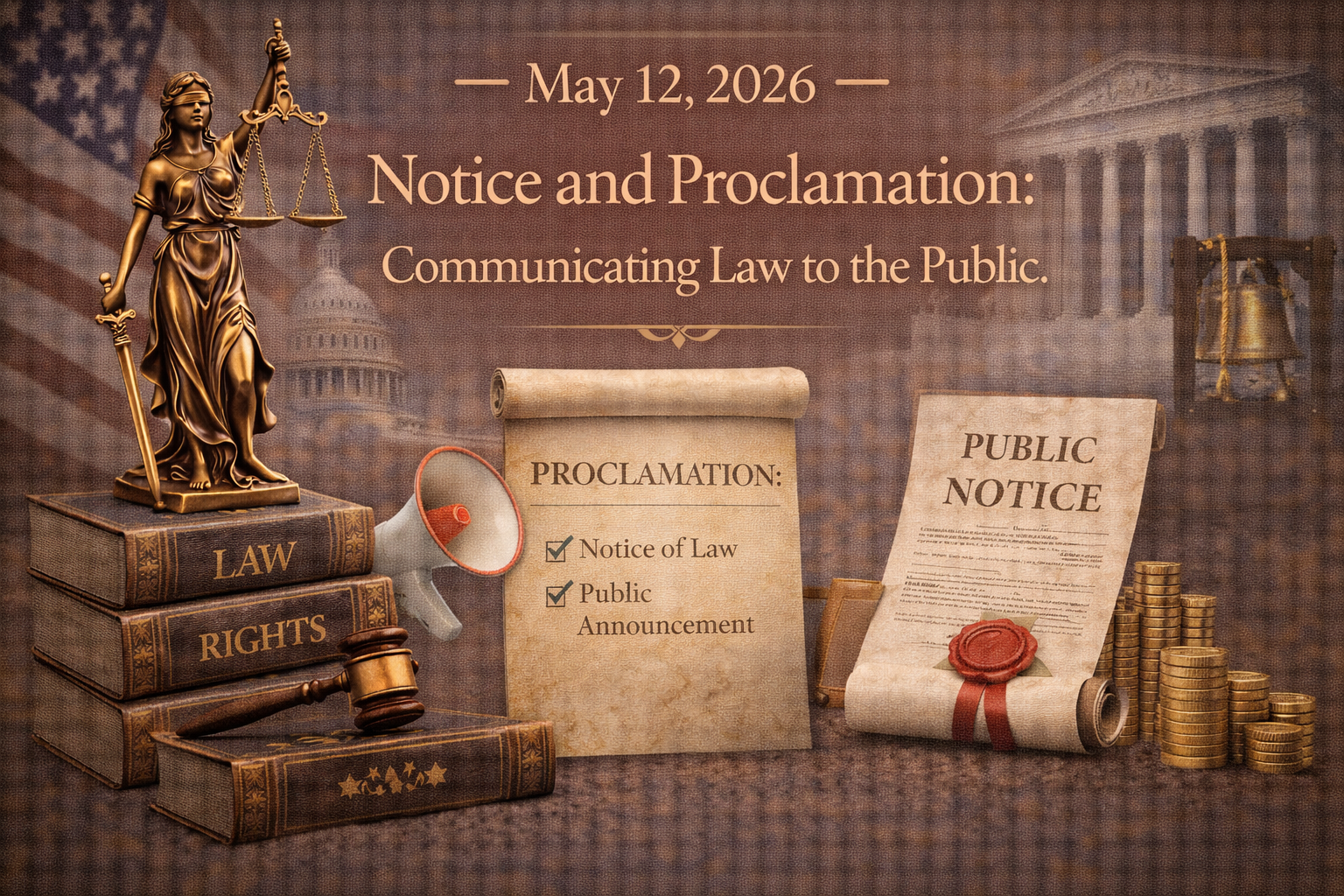
Part XIX — Notice and Proclamation: Communicating Law to the Public
For law to bind a community, it must be communicated and made known. Legal systems therefore rely upon the principles of notice and proclamation to inform the public of rules, rights, and obligations. Without notice, individuals cannot reasonably be expected to comply with legal requirements or defend their rights.
Notice and proclamation form essential components of due process and ensure that legal authority operates transparently within society.
—
I. The Word: Notice
Etymology
The word notice derives from the Latin notitia, meaning knowledge, awareness, or information.
The root noscere means to know.
Historically, notice referred to informing a person of facts or circumstances that require attention or response.
—
Black’s Law Dictionary
> Notice: “Legal notification required by law or agreement, or the formal communication of information.”
Notice ensures that individuals are aware of legal proceedings or obligations affecting them.
—
II. Forms of Legal Notice
Courts recognize several forms of notice.
Actual Notice
Actual notice occurs when a person receives direct knowledge of a legal matter.
Examples include:
• service of a summons
• personal delivery of documents
• written communication
—
Constructive Notice
Constructive notice exists when information is publicly available, even if the person has not personally seen it.
Black’s Law Dictionary
> Constructive Notice: “Notice arising by presumption of law from the existence of facts that a person had a duty to inquire about.”
Examples include:
• recorded property documents
• published statutes
• public registries
—
III. The Word: Proclamation
Etymology
The word proclamation derives from the Latin proclamare, meaning to call out publicly or declare openly.
Historically, proclamations were announcements made by rulers or governments informing the public of laws or official actions.
—
Black’s Law Dictionary
> Proclamation: “An official public announcement made by a governmental authority.”
Proclamations may include:
• executive declarations
• official notices
• governmental announcements of law
—
IV. Judicial Recognition of Notice Requirements
Courts emphasize that fair notice is essential to lawful proceedings.
—
Mullane v. Central Hanover Bank & Trust Co. (1950)
The Supreme Court of the United States held that notice must be reasonably calculated to inform interested parties of legal proceedings affecting their rights.
This decision established an important standard for due process.
—
Jones v. Flowers (2006)
The Court ruled that when notice is returned undelivered, the government must take additional reasonable steps to notify the affected party.
—
V. Publication of Laws
Governments commonly publish laws through official channels such as:
• legislative records
• government registers
• court opinions
• public archives
These publications provide public access to the law.
—
VI. Scriptural Reflections on Public Declaration
Sacred texts often emphasize the importance of openly declaring truth and guidance.
—
The Holy Bible
Isaiah 58:1
> “Cry aloud, spare not, lift up thy voice like a trumpet.”
Ecclesiastes 12:13
> “Fear God, and keep his commandments.”
These passages highlight the concept of openly proclaiming guidance and instruction.
—
The Qur’an
Surah Al-A’raf (7:2)
> “A Book revealed to you… that you may warn thereby.”
Surah Al-Baqarah (2:185)
> “Allah intends for you ease and does not intend hardship.”
These verses emphasize clear communication of guidance and law.
—
VII. Universal Law Insight
Across civilizations, law has been communicated through proclamation, public records, and formal notice. These mechanisms ensure transparency and allow individuals to understand the rules governing their conduct.
Notice and proclamation therefore support the fair administration of justice.
—
VIII. Practical Implication
When proceeding lawfully before a court or administrative authority, parties should ensure that:
1. notices are properly delivered or published
2. documents are recorded within official systems
3. legal requirements are clearly communicated to affected parties
These practices promote fairness and reduce disputes concerning legal obligations.
—
Closing Principle
Law must be known before it can be obeyed.
Through notice and proclamation, legal systems ensure that rules and obligations are communicated openly to the public.
—
Next Article in the Series
Part XX — Peace and Justice: The Final Aim of Law.


Leave a Reply