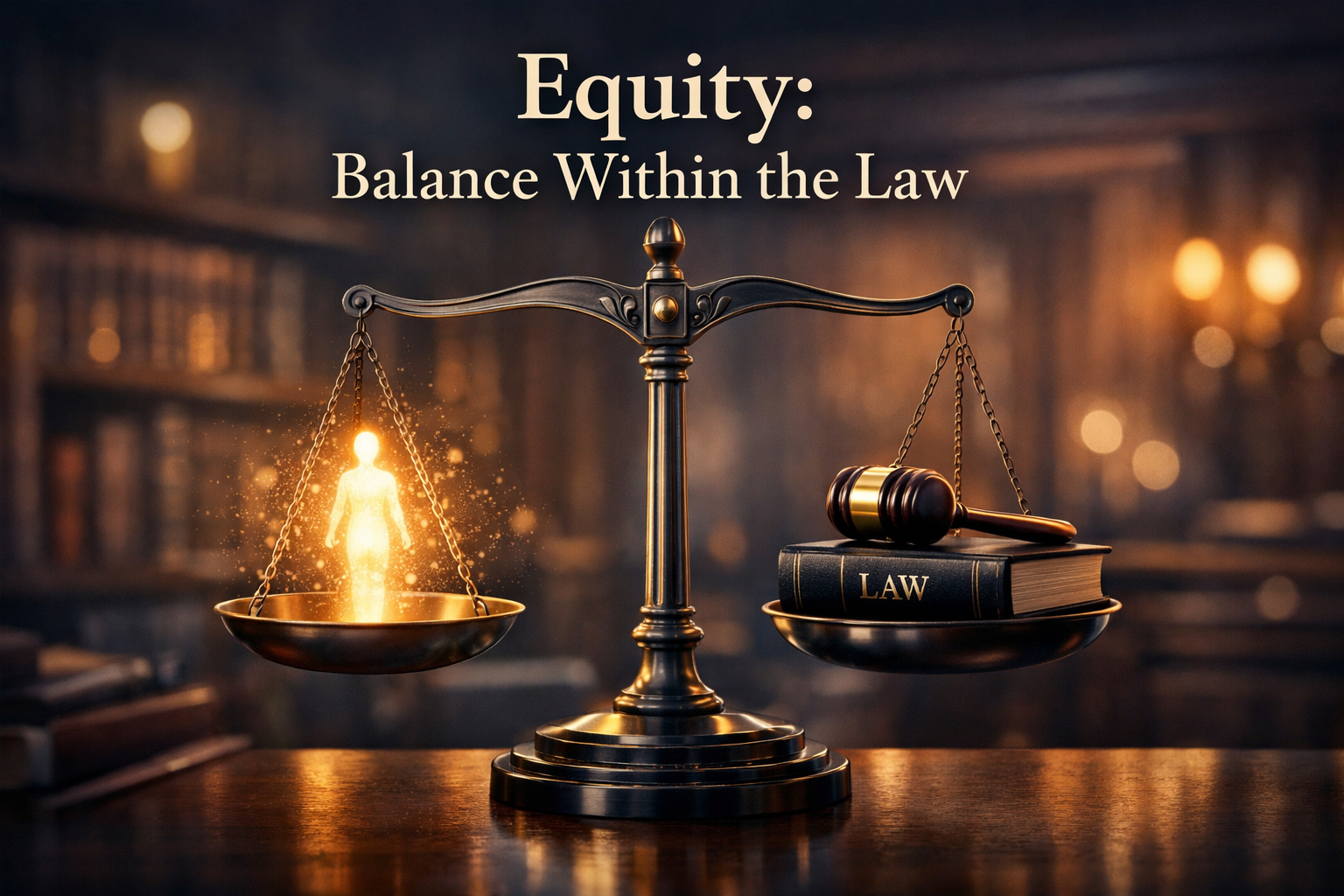


“Now we enter one of the most misunderstood dimensions of law.
If jurisdiction defines boundary…
If due process defines fairness of method…
Then equity defines justice when rigid rules fail.
This is where law breathes.”
—
Universal Law — Part V
Equity: Balance Within the Law
The word equity comes from Latin aequitas — meaning fairness, evenness, equality of proportion.
That root word aequus means level, balanced, even.
Equity is balance applied to justice.
Black’s Law Dictionary defines equity as:
> Justice administered according to fairness as contrasted with the strictly formulated rules of common law.
That distinction matters.
Common law relies on precedent and rigid forms.
Equity developed to correct situations where strict application of rules produced injustice.
—
The Historical Development of Equity
In medieval England, litigants who found no remedy in common law courts petitioned the King.
The King delegated such petitions to the Lord Chancellor.
Thus developed the Court of Chancery — a parallel system grounded in conscience and fairness.
Equity was not lawlessness.
It was correction.
It supplied remedies unavailable at common law, including:
Injunctions
Specific performance
Trust enforcement
It asked not merely, “What does the rule say?”
But “What is fair under these circumstances?”
—
Equity’s Structural Purpose
Rigid systems crack under exceptional facts.
Equity prevents fracture.
If a contract is obtained by fraud, strict enforcement is unjust.
If property is held in trust for another’s benefit, legal title alone is insufficient.
Equity looks behind form to substance.
The maxim often cited:
“Equity regards substance rather than form.”
This principle echoes universal law logic: structure must serve justice, not override it.
—
Supreme Court Recognition
The U.S. legal system merged law and equity procedurally in 1938 under the Federal Rules of Civil Procedure.
But the principles remain distinct.
In Hecht Co. v. Bowles, 321 U.S. 321 (1944), the Court affirmed that equitable remedies depend on balancing fairness and discretion.
Equity is not mechanical. It is calibrated.
In Grupo Mexicano de Desarrollo v. Alliance Bond Fund, 527 U.S. 308 (1999), the Court examined limits on equitable authority, reminding us that even equity has boundaries.
Equity corrects law — but does not replace structure.
—
Scriptural Parallels
Holy Bible — Micah 6:8
“…to do justly, and to love mercy, and to walk humbly…”
Justice with mercy.
Structure with balance.
Holy Qur’an — Surah An-Nahl (16:90)
“Indeed, Allah commands justice and excellence…”
Excellence here implies more than rigid compliance. It suggests moral refinement.
Across traditions, fairness tempers rule.
—
Equity and Universal Law
Universal law recognizes that systems require adaptability.
Biology adapts.
Ecology self-corrects.
Markets adjust.
Rigid systems without flexibility collapse under pressure.
Equity functions like a stabilizer — a shock absorber within law.
But here is the caution:
Unbounded discretion becomes arbitrariness.
So equity itself must operate within jurisdiction and due process.
Balance within balance.
—
The Maxims of Equity
Equity developed guiding principles, including:
Equity follows the law.
He who seeks equity must do equity.
Equity aids the vigilant, not those who sleep on their rights.
Clean hands doctrine — one seeking equitable relief must not be guilty of misconduct in the matter at issue.
These maxims reinforce universal patterns:
Reciprocity.
Accountability.
Timeliness.
Integrity.
They are structural moral constraints.
—
Why Equity Matters
Without equity, law becomes rigid machinery.
Without law, equity becomes subjective preference.
Together they form a dual system:
Rule + balance
Structure + conscience
Form + substance
This duality mirrors universal design — constraint paired with adaptability.
—
A Deeper Observation
Every enduring system has two layers:
1. A rule-based framework
2. A corrective mechanism
Constitutions have amendments.
Science has peer review.
Courts have equity.
Systems that lack corrective mechanisms ossify.
Systems that lack structure dissolve.
Universal law examines the harmony between the two.
—
Working Conclusion
Equity is the balancing principle within jurisdiction and due process.
It does not abolish law.
It refines it.
It prevents mechanical injustice.
It ensures that fairness remains central, even when facts resist rigid categories.
Next, we examine a concept that limits who may invoke judicial power at all:
Standing — the requirement of real injury and real controversy.


Leave a Reply