

—
Universal Law — Part II
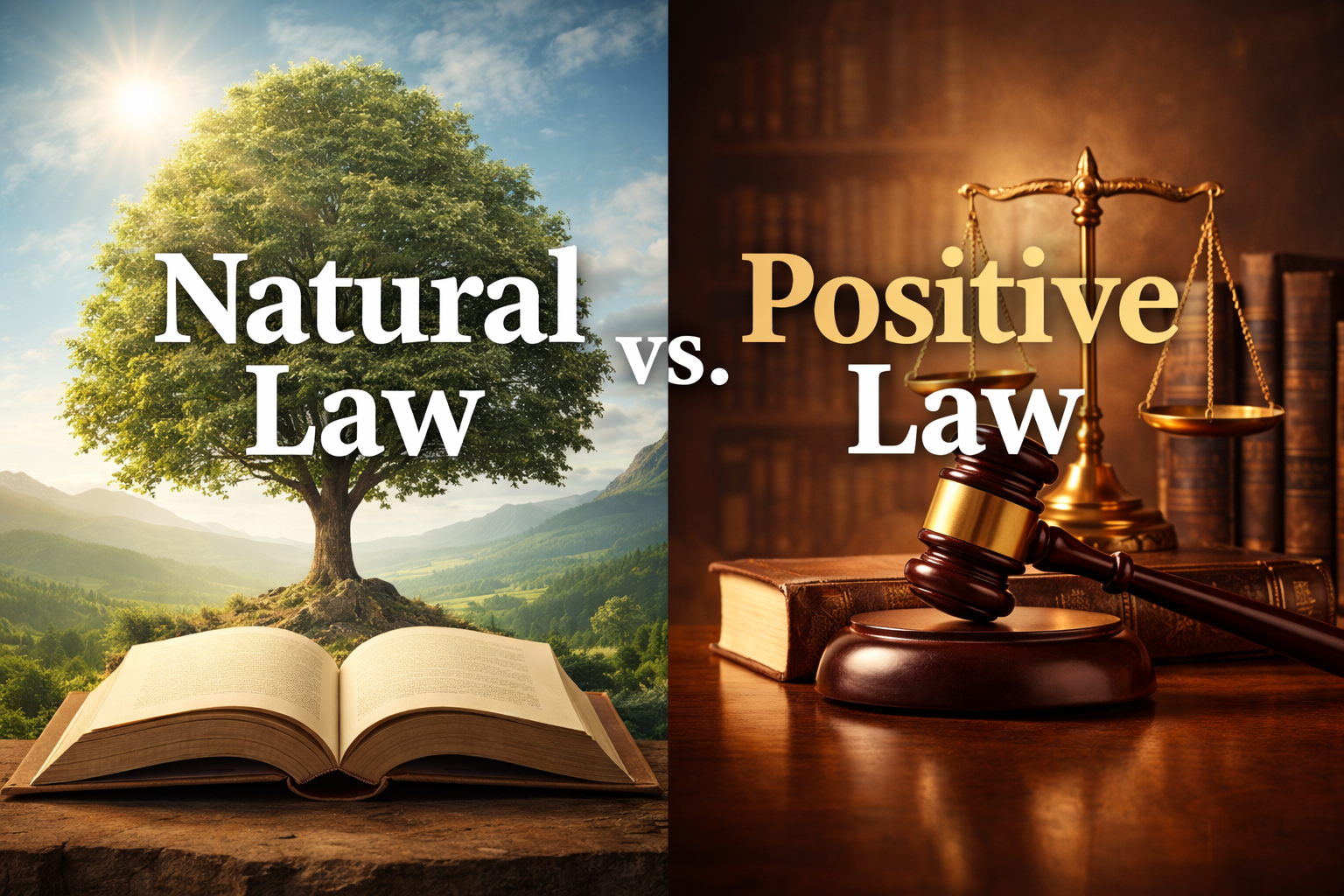
Natural Law vs. Positive Law
There is a difference between a rule and a right.
A rule is written.
A right is recognized.
That distinction is the fault line between natural law and positive law.
—
What Is Positive Law?
“Positive” does not mean good. It comes from Latin positus — “placed” or “posited.”
Positive law is law placed into existence by a governing authority.
Black’s Law Dictionary defines positive law as:
> Law actually and specifically enacted or adopted by proper authority for the government of an organized society.
Statutes. Regulations. Codes. Executive orders.
These are positive law.
They are human constructs.
They can be amended, repealed, expanded, or abused.
—
What Is Natural Law?
Natural law, by contrast, is not enacted — it is inferred.
Black’s Law Dictionary defines natural law as:
> A system of principles and rules of conduct derived from nature and the nature of man, considered as binding in conscience.
Notice the language: binding in conscience.
This idea appears across civilizations.
Aristotle argued that some acts are unjust “by nature.”
Cicero wrote of “true law” as right reason in agreement with nature.
Aquinas described natural law as participation in eternal law through reason.
This is not mythology. It is philosophical observation: some principles appear universal.
Unprovoked harm is condemned nearly everywhere.
Theft destabilizes trust in every society.
False witness undermines justice in every courtroom.
—
When Positive Law Contradicts Natural Law
History gives uncomfortable examples.
Slavery was once lawful under positive law in the United States.
Segregation statutes were once enforceable.
Yet in Brown v. Board of Education, 347 U.S. 483 (1954), the Supreme Court declared segregation unconstitutional.
Why?
Because deeper constitutional principles — equal protection — outweighed statutory constructs.
Earlier, in Dred Scott v. Sandford, 60 U.S. 393 (1857), the Court infamously upheld slavery interests under positive law reasoning. That decision is now widely regarded as a moral and constitutional failure.
This tension reveals something critical:
Positive law can be valid procedurally and still violate deeper principles.
That is the fracture line universal law seeks to examine.
—
Scriptural Convergence
Holy Bible — Acts 5:29
“We ought to obey God rather than men.”
This is a natural law assertion: moral obligation may supersede human command.
Holy Qur’an — Surah An-Nisa (4:58)
“Indeed, Allah commands you to render trusts to whom they are due and when you judge between people to judge with justice.”
Justice is presented as a standard above rulers.
Across traditions, the pattern repeats: authority is legitimate only when aligned with justice.
—
Constitutional Structure as Natural Law Echo
The U.S. Constitution reflects natural law influence.
The Declaration of Independence speaks of “Laws of Nature and of Nature’s God.”
It asserts that rights are “unalienable” — meaning not granted by government.
Unalienable implies pre-existing.
The Supreme Court has acknowledged limits on governmental authority repeatedly:
Marbury v. Madison (1803) — unconstitutional acts are void.
West Virginia State Board of Education v. Barnette, 319 U.S. 624 (1943) — the government cannot compel speech, affirming limits even during wartime.
Justice Jackson wrote in Barnette:
“No official, high or petty, can prescribe what shall be orthodox…”
That sentence breathes natural law logic.
—
The Stability Test
Here is a practical test.
Positive law survives when aligned with underlying structure.
It destabilizes when it contradicts fundamental principles like:
Equal application
Due process
Proportionality
Accountability
When a system abandons these, instability increases.
This is observable historically. Empires that centralize power without restraint eventually fracture — not because prophecy demands it, but because systems out of balance collapse.
Entropy applies to institutions too.
—
The Philosophical Edge
Universal law does not automatically invalidate positive law.
It interrogates it.
It asks:
Does this rule align with reason?
Does it protect inherent dignity?
Does it preserve structural balance?
Does it respect jurisdictional boundaries?
If the answer is yes, positive law stands strengthened.
If the answer is no, tension builds — socially, politically, and legally.
—
Why This Matters for Courts
Courts do not openly declare “natural law review.” They interpret constitutions, statutes, and precedent.
Yet constitutional interpretation often involves principles not reducible to text alone.
Concepts like:
Fundamental fairness
Substantive due process
Equal protection
These are interpretive bridges between positive enactment and deeper principles.
The law rarely says, “We are applying universal law.”
But it frequently invokes justice, fairness, and reason.
Those are not arbitrary words. They carry centuries of philosophical weight.
—
Working Conclusion
Positive law is necessary for order.
Natural law is necessary for legitimacy.
Without positive law, there is chaos.
Without natural law, there is tyranny.
Universal law is the discipline of examining where those two intersect — and where they diverge.
And divergence is where the most important legal struggles occur.
Next, we turn to a concept that defines boundaries of authority itself:
Jurisdiction — the boundary principle of power.


Leave a Reply